Finding the right corner guard shouldn’t mean trusting a small package and a bold “childproof” label. The 9 Corner Guard Features Every Parent Should Look For determine whether a guard cushions a bump or creates another hazard. You need complete coverage, resilient material, secure attachment, and product-specific safety information.
As of 2026, the CPSC doesn’t provide one universal pass mark for general-use furniture corner guards. That means the product’s materials, warnings, mounting method, and test details need a closer look. Under 16 CFR § 1500.19, the small-parts cylinder measures 1.25 inches in diameter by 2.25 inches deep when that rule applies.
It offers one useful warning for detachable parts, not a complete safety rating.
9 Corner Guard Features Every Parent Should Look For
Quick Answer
9 Corner Guard Features Every Parent Should Look For start with full coverage. Choose resilient material that resists tearing and compression. Match mounting to the surface and expected contact.
Verify chemical, temperature, and aging information. Use guards alongside safer furniture placement and supervision.
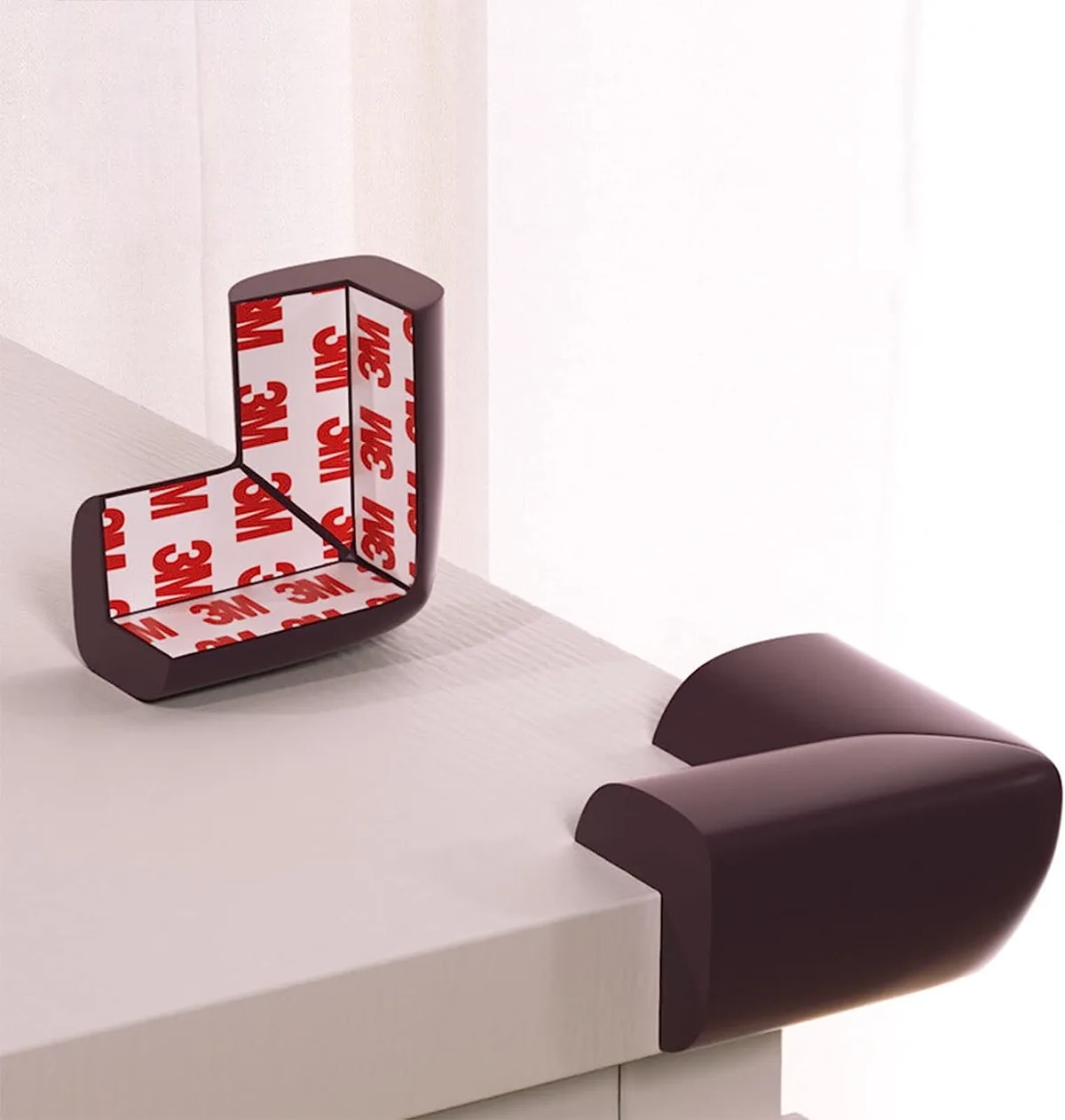
Image source: Bing (Web (fair-use with source credit))
How Corner Guards Work and Where They Stop Working
A furniture corner guard is a soft or semi-rigid cover fitted over a sharp furniture edge. Its job is impact attenuation, which means reducing peak force by deforming and dissipating energy. A good guard also limits rebound and stays fixed when a child bumps, grabs, or pulls it.
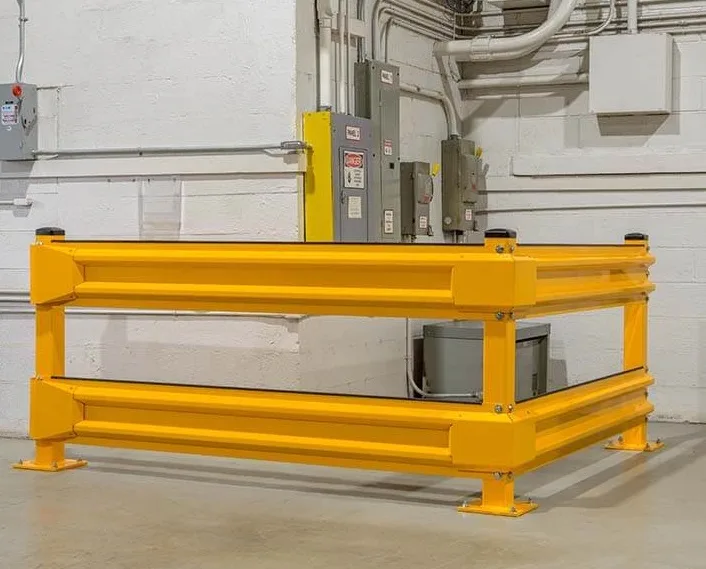
Image source: Web (Bing) / safetyfencesystems.com (Web image (fair-use with source credit))
Fit is part of the safety feature. The guard should stay in contact with the corner during a sideways bump, not just cover the top tip. It also needs enough thickness to compress without splitting or sliding.
Complete coverage should include the corner point, top, both vertical faces, and the front edge. A small cap may work for a minor scrape, but it won’t handle a forehead or shoulder strike as well as a full edge guard.
Corner guards may soften minor contact, but they don’t prevent falls or stop furniture from tipping. Remove hazards where possible, anchor tall furniture, and control access to window-opening risks. The [U.S.
Consumer Product Safety Commission](https://www.cpsc.gov/) recommends combining safer placement, supervision, and secure furniture rather than relying on one product.
Industrial wall guards and warehouse bumpers serve a different purpose. They’re made to stop carts, pallets, and equipment from damaging walls. They aren’t substitutes for cushioned child-use protection.
The 9 Corner Guard Features Every Parent Should Look For
Specific, model-based evidence matters more than a broad safety slogan. “Shock absorbing” alone doesn’t tell you what was tested, how hard the impact was, or whether the guard stayed attached.
1. Verified impact attenuation with controlled rebound
Look for controlled deformation, limited rebound, and secure retention during impact. A useful report should give the impact weight, drop height, target surface, cycle count, peak force, and condition after testing.
2. Resilient material that resists compression and tearing
Choose material that recovers after compression and resists cracking, chewing, and shearing. Compression set is permanent flattening after repeated loading, so a guard that stays compressed may provide less protection over time.
Silicone, rubber, and thermoplastic elastomer, or TPE, are common resilient alternatives. Their suitability depends on hardness, aging, surface finish, and the product’s complete construction.
3. Complete coverage of the corner and adjacent edge
The guard should cover the point, both sides, the top, and enough of the front edge. Check the dimensions against the actual furniture. Don’t rely on a broad size range when the guard leaves a sharp section exposed.
4. Smooth construction without exposed hazards
The outer surface should be rounded, snag-free, and free of sharp rims. Exposed screws, rigid end caps, open seams, and pinch points can create new injury risks. Every detachable piece also needs to be inaccessible to children who may pull or chew on it.
5. Retention strong enough to survive handling
Peel resistance helps stop an edge from lifting, while shear resistance helps prevent sliding. One-piece construction and captive end sections may improve security. Even then, the adhesive or fastener system must match the surface and expected contact.
6. A mounting method matched to the surface and load
Use adhesive only when the manufacturer approves the exact finish. Use screws, bolts, or nails only when the instructions allow them and the furniture can support the fastener. A strong mount on particleboard can still pull out the material beneath it.
7. Product-specific chemical, temperature, and fire information
Check the guard, foam, adhesive, and coatings as one product system. Useful documents identify ingredients or testing where relevant. Broad terms such as “non-toxic,” “BPA-free,” or “eco-friendly” don’t explain what was measured.
Temperature limits matter near sunny windows, heaters, and fireplaces. A UL 94 material rating can describe flammability behavior, but it doesn’t approve the finished corner guard or prove child safety.
8. Cleanability and resistance to moisture, UV exposure, and aging
Look for a nonporous surface that tolerates the household cleaner used nearby. Closed-cell materials are often easier to wipe down than open-cell foam. Check storage conditions, service temperature, moisture limits, and documented replacement guidance.
9. Correct sizing, visibility, and replacement ease
Match the guard to the corner’s width, height, angle, and exposed edge length. Choose a visible clear, neutral, or matched finish that helps caregivers spot damage. Developmental stage matters more than a printed age, just as it does when assessing forward-facing readiness.
How to Compare Materials, Mounting Methods, and Real Specs
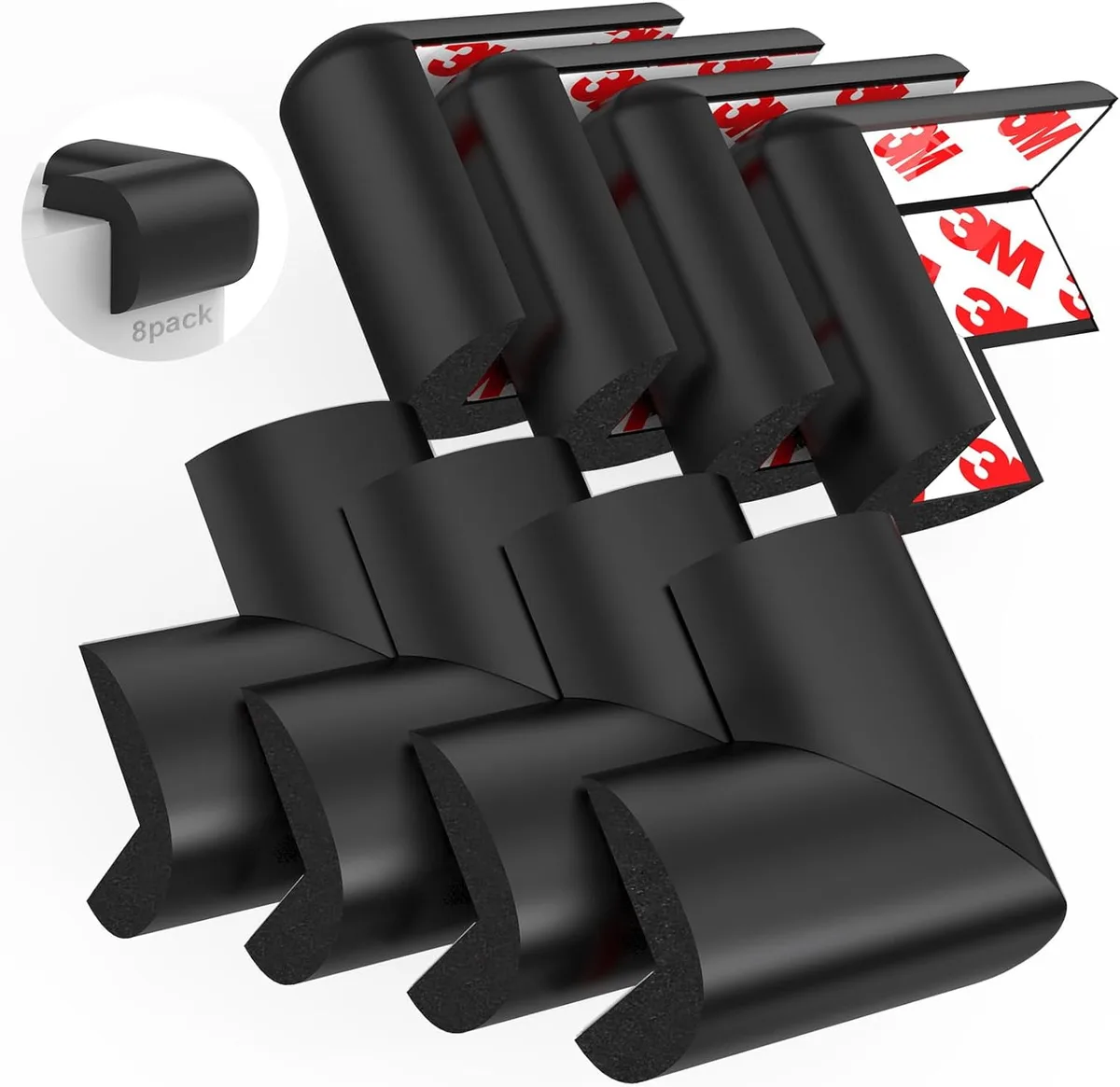
Image source: Web (Bing) / walmart.com (Web image (fair-use with source credit))
Choose the material for the contact pattern
No material wins in every setting. Consider how often children pass through the area, whether they grab or bite surfaces, and how difficult the furniture is to clean or replace.
| Material | Main strengths | Common drawbacks | Best fit |
|---|---|---|---|
| Foam | Soft feel and low rebound | Can flatten, tear, or trap dirt | Lower-load corners with regular checks |
| Silicone | Washable, tough, and shape-retaining | May cost more or feel firmer | Repeated handling and damp rooms |
| Rubber or TPE | Durable with good shape recovery | Can harden or lose flexibility | High-wear areas with compliant models |
| Hard plastic | Durable and easy to wipe | Little cushioning and greater rebound | Usually avoid for child-facing corners |
Foam density only compares foams. Shore hardness can help compare some rubber or TPE products, but it doesn’t create a common scale for foam, silicone, and plastic.
Match the mounting method to the surface
Adhesive mounting is quick and may be renter-friendly when the lease permits it. Mechanical fasteners can offer stronger retention, but they can strip wood, crack glass, or damage stone.
- Use adhesive only on an approved clean, dry surface.
- Don’t stretch adhesive across a gap or around a poorly fitting edge.
- Use fasteners only when the maker confirms the material can accept them.
- Follow the stated cure time before returning furniture to use.
If a play route includes feeding equipment, keep it clear as well. Drying rack organization can help prevent unrelated household items from becoming obstacles.
Read specifications that reflect real performance
Coverage dimensions are the first check. Look for length, height, thickness, and the protected edge distance in both inches and millimeters.
Other useful measurements include compression set, peel strength, shear strength, service temperature, and performance after repeated impacts. A drop-test claim should identify the impact weight, height, surface, cycle count, and post-test condition.
If those details are missing, treat the claim as unverified. Don’t compare a foam guard’s density with a rubber guard’s hardness and assume both provide equal protection.
Compare furniture guards with other options
Full-length edge pads cover an exposed side better than a corner-only guard. Decorative cushions may look soft, but they can shift during a fall. Wall guards mainly prevent surface damage.
Moving a hazardous table out of the play area is often more reliable than covering it. Crib bumper products are separate sleep-area items and don’t belong inside an infant’s crib.
A Step-by-Step Selection and Installation Guide
A careful setup can turn a suitable guard into a dependable safety layer. You’ll need a tape measure, clean cloth, manufacturer-approved cleaner, and any specified mounting hardware.
Map your child’s movement. Watch where your child crawls, stands, walks, and climbs. Mark pointed corners along those repeated routes.
Remove the hazard first. Move the furniture, close off access, or replace it with a safer design. A guard shouldn’t be the only option when the entire hazard can be eliminated.
Measure the corner. Record its width, height, angle, and exposed edge length. Confirm that the guard covers the top, both faces, and the front edge.
Check the exact model documentation. Confirm approved surfaces, included hardware, temperature limits, cure time, warnings, and model-specific test information.
Prepare the surface gently. Clean and dry it using the maker’s method. Test a hidden area first on porous, painted, veneered, or easily marked finishes.
Install without gaps or tension. Fit the guard without stretching it. Keep adhesive fully supported and any fastener heads flush or protected.
Allow the full cure time. The cure period is part of installation. Don’t assume that a few hours will equal the time printed on the package.
Inspect the finished installation. Check seams, edges, fasteners, adhesive contact, and nearby surfaces. Don’t perform an impact test with a child.
If adhesive lifts at one edge, remove it rather than forcing it back into place. Dirty or damaged adhesive may need removal and surface cleaning before a new guard is fitted.
Safety, Legal, and Compliance Checks That Actually Apply
A corner guard is acceptable only if it stays attached, covers sharp edges, and creates no accessible small parts. Treat lifted seams, exposed screws, chewable foam, and rigid rims as stop-use conditions.

Image source: Web (Bing) / printables.com (Web image (fair-use with source credit))
Which construction risks matter most?
Detachable end caps and loose adhesive tabs can become choking hazards. Open seams may snag clothing or fingers, while rigid plastic can create rebound during a collision.
Don’t install guards on heated surfaces or near an active fireplace unless the documentation permits it. Keep every guard outside a crib and sleep space, where loose objects can create suffocation or entrapment risks.
Which U.S. rules may apply?
The legal category depends on the product’s design, intended use, marketing, and how it’s sold. A general furniture accessory doesn’t automatically become a toy or child-care article, so don’t assume that every children’s product rule applies.
When the Children’s Product Safety Improvement Act and 16 CFR Part 1250 apply, lead limits are 90 ppm in covered substrates and 100 ppm in surface coatings. See the current 16 CFR Part 1250 text for scope and compliance details.
If a product legally falls within the covered toy or child-care article rules, each listed phthalate is limited to 0.1% by weight. A Children’s Product Certificate may also be required for a covered children’s product subject to a CPSC rule. Imported products subject to such a rule may need a Generic Certificate of Conformity.
What certifications and labels don’t prove
ASTM F963 and EN 71 apply when the product falls within their toy-safety scope. UL 94 describes tested material flammability behavior. A CE mark means applicable EU requirements were declared, not that an independent laboratory approved the product.
“FDA approved” isn’t a general corner-guard safety category. A California Proposition 65 warning also isn’t a general safety certification. Look for a model number, manufacturer, supplier, warnings, chemical information, mounting instructions, and traceable test details.
Real-World Use, Maintenance, and Replacement
A guard earns its place only while it remains fixed and fully covers the edge. Match your response to the child’s movement stage, contact pattern, and furniture finish.
| Situation | Better response |
|---|---|
| Newly crawling infant | Target floor-level corners along common routes |
| Walking toddler | Cover points and longer exposed edge zones |
| Active climber | Combine guards with anchoring and access control |
| Glass or natural stone | Relocate the furniture when possible |
| Rental home | Use a removable system only after checking the lease and surface |
| Childcare setting | Record inspections and use documented products |
Check bonded guards during routine safety reviews and after any collision, vigorous pull, chewing event, or nearby renovation. The same fault-finding discipline used for stroller brake faults helps here.
Replace any guard that lifts, splits, flattens permanently, stretches, or exposes its core. There’s no universal service life. Contact, heat, sunlight, cleaning chemicals, and adhesive quality all affect how long a guard works.
Record the model, installation date, surface, and replacement date. Product identifiers help with instruction changes and recalls, much like keeping equipment service records for other child equipment.
Remove the guard when your child no longer reaches the corner. Clean the surface with a compatible adhesive remover, and don’t soak foam or scrape residue from glass, stone, or delicate finishes.
Corner-Guard FAQs and Final Decision Checklist
Are foam corner guards always the safest option?
No. Foam can feel soft and limit rebound, but it may flatten or tear. Choose foam only when its compression, tear resistance, coverage, and attachment are documented.
Silicone, rubber, or thermoplastic elastomer may last longer in a high-use area if the model remains compliant and securely attached.
Can a corner guard prevent serious falls or furniture tip-overs?
No. A suitable guard may soften a minor bump, but it cannot prevent every fall or stop furniture from tipping. Keep hazards out of reach, supervise your child, and use appropriate anti-tip anchors.
A guard doesn’t change when a significant head injury needs prompt medical assessment.
Should corner guards ever be placed in a crib or sleep space?
No. Keep loose corner guards, cushions, and bumper products out of cribs and sleep spaces. They can create suffocation, entrapment, or choking risks.
Use only products specifically approved for the sleep environment, and follow current safe-sleep guidance for the baby’s age and development.
Which mounting method is safest for common furniture finishes?
It depends on the surface and furniture construction. Use adhesive only when the manufacturer approves the finish and states a cure time. Use fasteners only on compatible, sound materials.
Moving the furniture is safer than drilling glass, natural stone, thin laminate, or weak particleboard without specific manufacturer approval.
How can I tell whether an adhesive guard is secure?
Confirm full surface contact, complete cure time, intact edges, and firm retention around the entire corner. Reject guards with bubbles, lifted corners, stretched adhesive, or exposed residue. Check them after collisions and vigorous handling.
If the bond keeps failing, replace the guard rather than adding more tape over a weak attachment.
What should I choose when removing the hazard is possible?
Choose furniture relocation, access control, or a safer room layout whenever they work. If the corner must remain, select complete coverage, resilient material, secure retention, and a mounting method approved for that surface. Replace the guard after significant impact, repeated detachment, visible aging, or permanent loss of shape.

Sophia Linda is a freelance writer and Certified Health Coach based in the Newbury Park, CA. Passionate about healthy living, she focuses on helping families stay active and connected to the outdoors. Together with her husband and their three young children, Sophia spends much of her time traveling, hiking, and camping. Her work has been featured on the bestbabycart blog, and she brings a practical, real-world perspective to reviewing baby products for parents.