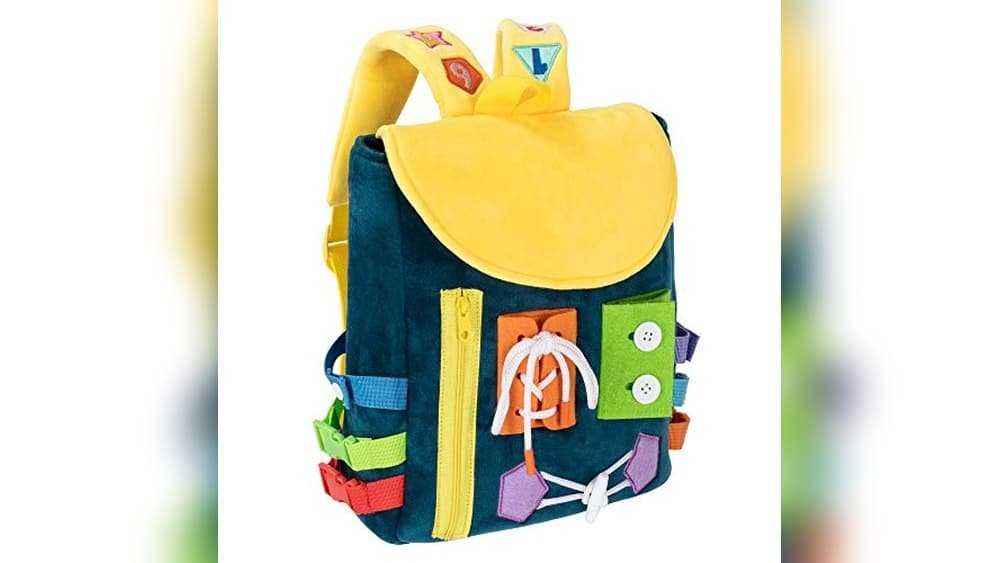
Toddler development in 2026 prioritizes screen-free, skill-building play that supports long-term independence, and zipper and buckle busy boards have become a top tool for parents and caregivers looking to build foundational fine motor skills. These hands-on toys replicate real-world dressing fasteners in a low-pressure, error-free environment, letting toddlers practice critical tasks without the frustration of rushing to get dressed. Fine motor skill mastery is a core 24-month milestone per CDC Early Development Milestones, and regular practice with busy boards builds the muscle memory, dexterity, and confidence toddlers need to dress themselves, hold writing utensils, and complete other daily tasks independently. This guide breaks down the developmental benefits of zipper and buckle busy boards, what to look for in a high-quality option, top reviewed products, and tips to maximize skill building.
Why Zipper and Buckle Skills Are Foundational for Toddler Development
Fine motor skills refer to the coordination of small hand and finger muscles to complete precise, controlled tasks. For toddlers, mastering these skills is a critical stepping stone to independence: by 24 months, most children can manipulate small objects, turn book pages, and begin practicing simple dressing tasks like pulling off socks and unzipping large zippers, per current CDC guidelines. By 36 months, they should be able to button large buttons, pull up zippers fully, and begin tying simple knots. You can also read our guide on best wooden puzzles with large knobs.
Zipper and buckle practice specifically targets four core skill areas that transfer to countless daily tasks:
- Pincer grasp strength: Pinching zipper pulls and buckle tabs builds the same finger muscles used for holding crayons, picking up small snacks, and turning page corners.
- Bilateral coordination: Using both hands to guide a zipper along its track or squeeze a buckle release teaches toddlers to coordinate both sides of their body, a skill critical for tasks like cutting with scissors and riding a tricycle.
- Finger dexterity: Twisting, pulling, and pressing small fasteners builds the fine, controlled movements needed for detailed tasks like buttoning shirts and typing later in life.
- Hand-eye coordination: Aligning a buckle prong with a hole or guiding a zipper along its track teaches toddlers to match their hand movements to visual cues, a skill that supports sports, writing, and other coordinated activities.
A common mistake parents make is waiting until toddlers are expected to dress themselves independently to practice fastener skills, which often leads to frustration and dressing-related tantrums. Low-stakes play with busy boards builds muscle memory before the pressure of real dressing routines begins, making the transition to independent dressing far smoother.
How Zipper Buckle Busy Boards Support Skill Building
Busy boards are purpose-built to mimic real-world fasteners in a way that is accessible to small, still-developing hands. Unlike real clothing, which can be stiff, too small, or cause frustration when a toddler can’t fasten it quickly, busy board fasteners are often oversized, have textured pull tabs for easy gripping, and require less force to manipulate. This lets toddlers practice repeatedly without adult intervention, building confidence and skill through self-directed play. You can also read our guide on sassy baby toys developmental set.
Montessori-aligned busy boards are particularly effective, as they follow the educational philosophy of learning through practical, hands-on activities. These boards encourage independent exploration, letting toddlers practice at their own pace without correction or pressure. For toddlers with sensory processing differences, the tactile feedback of different fasteners (smooth zippers, textured buckles, rigid snaps) provides additional sensory input that supports focus and engagement during play.
Key Features to Look for in a Quality Zipper Buckle Busy Board
Not all busy boards are built equal, and choosing the right one for your toddler’s age and skill level will maximize skill building and minimize frustration. Prioritize these features when shopping:
- Safety certification: Look for toys certified to meet ASTM Toy Safety Standards, which enforce strict limits on toxic materials, require all fasteners to be securely attached (no detachable small parts that pose choking hazards), and mandate smooth edges to prevent injury.
- Age-appropriate fastener sizing: For 12–24 month olds, choose boards with oversized, easy-to-grasp buckles and zippers with large, textured pull tabs. For 24–36 month olds, boards with smaller, more realistic fasteners (including shoe-tying laces) are appropriate to build more advanced skills.
- Durable construction: Solid wood boards hold up to rough play for years, while foam boards are softer and safer for younger toddlers who are still building grip strength. Avoid boards with flimsy plastic components that break easily with repeated use.
- Portability: If you plan to use the board for travel, look for lightweight designs (under 1 pound) with no sharp corners, that fit easily in a diaper bag or car seat organizer.
- Skill variety: Prioritize boards that include a range of fasteners (zippers of different sizes, multiple buckle types, snaps, buttons, laces) to build a full range of dressing skills, rather than a single repeated fastener that will lose your toddler’s interest quickly.
Top Zipper Buckle Busy Boards for Toddler Development
We’ve evaluated the most popular options on the market based on safety, durability, skill-building value, and parent feedback to help you choose the best fit for your family.
1. Busy Board Toddler Backpack (Navy Blue)
 Compact travel-friendly busy board designed for on-the-go fine motor skill practice
This versatile board doubles as a wearable backpack, making it ideal for toddlers who enjoy carrying their own toys. It features a mix of age-appropriate practice fasteners: a large side-release buckle, a shoe-tying practice station with real laces, and a small zipper with an easy-grip pull tab. At 11 x 9 x 3.9 inches and 0.55 pounds, it’s lightweight enough for toddlers to carry themselves, and fits easily into a toddler backpack diaper bag for outings. The durable nylon construction holds up to daily use, and the neutral navy color works for any child. It’s best for toddlers 18 months and older who are ready to practice basic buckling and shoe-tying skills.
Compact travel-friendly busy board designed for on-the-go fine motor skill practice
This versatile board doubles as a wearable backpack, making it ideal for toddlers who enjoy carrying their own toys. It features a mix of age-appropriate practice fasteners: a large side-release buckle, a shoe-tying practice station with real laces, and a small zipper with an easy-grip pull tab. At 11 x 9 x 3.9 inches and 0.55 pounds, it’s lightweight enough for toddlers to carry themselves, and fits easily into a toddler backpack diaper bag for outings. The durable nylon construction holds up to daily use, and the neutral navy color works for any child. It’s best for toddlers 18 months and older who are ready to practice basic buckling and shoe-tying skills.
- Pros: Wearable design encourages independent play, multiple fastener types, durable construction
- Cons: Smaller size may be challenging for toddlers with larger hands, limited color options If you want a portable, dual-purpose option to build your toddler’s dressing independence, this toddler backpack busy board offers consistent practice opportunities for on-the-go learning.
2. Buckle Toys Green Busy Board
 Lightweight travel busy board sized to fit easily in diaper bags and car seat organizers
This compact board from trusted brand Buckle Toys is designed exclusively for 1 to 2 year old toddlers, with 6 different buckle types of varying sizes and release mechanisms to build progressive skill mastery. At 8.54 x 10.98 inches and 0.31 pounds, it’s slim enough to tuck into a convertible car seat organizer or diaper bag pocket for road trips or waiting room visits. The soft foam base is gentle for young toddlers who are still building grip strength, and all buckles are securely attached to meet ASTM safety standards. It’s a great pick for families prioritizing travel-friendly skill building.
Lightweight travel busy board sized to fit easily in diaper bags and car seat organizers
This compact board from trusted brand Buckle Toys is designed exclusively for 1 to 2 year old toddlers, with 6 different buckle types of varying sizes and release mechanisms to build progressive skill mastery. At 8.54 x 10.98 inches and 0.31 pounds, it’s slim enough to tuck into a convertible car seat organizer or diaper bag pocket for road trips or waiting room visits. The soft foam base is gentle for young toddlers who are still building grip strength, and all buckles are securely attached to meet ASTM safety standards. It’s a great pick for families prioritizing travel-friendly skill building.
- Pros: Progressive buckle difficulty, lightweight foam construction, meets safety standards
- Cons: Only available in green, limited to buckling practice (no zippers or laces) For a durable, travel-ready option focused exclusively on buckling skill mastery, this green busy board is a reliable pick for 1-year-old toddlers.
3. Kghios Montessori BusyBoard
 Multi-activity board covering 6 common dressing fasteners for preschool skill building
This budget-friendly board covers all core dressing fasteners in one compact package: a zipper, metal snap, large button, side-release buckle, lace, and shoe-tying practice station. At 7.48 x 9.37 x 1 inch, it’s small enough for toddlers to hold independently, and the sturdy wood construction holds up to daily use. It aligns with Montessori practical life learning principles, encouraging independent, self-directed practice of dressing skills. It pairs well with a shape-sorting activity cube for well-rounded fine motor skill development, and is best for 18 to 36 month olds who are ready to practice a full range of dressing tasks.
Multi-activity board covering 6 common dressing fasteners for preschool skill building
This budget-friendly board covers all core dressing fasteners in one compact package: a zipper, metal snap, large button, side-release buckle, lace, and shoe-tying practice station. At 7.48 x 9.37 x 1 inch, it’s small enough for toddlers to hold independently, and the sturdy wood construction holds up to daily use. It aligns with Montessori practical life learning principles, encouraging independent, self-directed practice of dressing skills. It pairs well with a shape-sorting activity cube for well-rounded fine motor skill development, and is best for 18 to 36 month olds who are ready to practice a full range of dressing tasks.
- Pros: Covers all common fasteners, affordable, Montessori-aligned
- Cons: Smaller size may be challenging for toddlers with less developed grip strength, wood surface requires occasional wiping to clean If you want an all-in-one board to cover every basic dressing skill your preschooler needs to master, this multi-activity Montessori busy board offers exceptional value.
4. Buckle Toys Mini Busy Board
 Pocket-sized travel toy ideal for keeping toddlers engaged during short trips
At just 6 x 8 x 1 inch and 0.2 pounds, this is the most portable option on our list, fitting easily into a coat pocket or small diaper bag pouch. It features 4 different buckle types with different release mechanisms, designed to build progressive buckling skills for 1 year old toddlers. The bright green color is visually stimulating for young children, and the soft foam base is safe for independent play. It pairs well with a portable changing pad for streamlined outings with young kids, and is ideal for quick trips to the grocery store or doctor’s office.
Pocket-sized travel toy ideal for keeping toddlers engaged during short trips
At just 6 x 8 x 1 inch and 0.2 pounds, this is the most portable option on our list, fitting easily into a coat pocket or small diaper bag pouch. It features 4 different buckle types with different release mechanisms, designed to build progressive buckling skills for 1 year old toddlers. The bright green color is visually stimulating for young children, and the soft foam base is safe for independent play. It pairs well with a portable changing pad for streamlined outings with young kids, and is ideal for quick trips to the grocery store or doctor’s office.
- Pros: Ultra-portable, bright engaging color, soft foam construction
- Cons: Limited to buckling practice, small size may be challenging for toddlers with less developed fine motor skills For a no-fuss, pocket-sized option to keep your 1-year-old engaged during short outings while building essential fine motor skills, this mini busy board is a perfect pick.
5. Learning to Dress Busy Board by Lerdots
 Classroom-friendly busy board designed to teach full dressing routines to preschoolers
This larger, multi-activity board is designed for both home and preschool classroom use, with 8 different fasteners covering every step of a dressing routine: buttons, snaps, a zipper, two buckle types, laces, a shoe-tying station, and a velcro strap. At 8 x 10.4 inches and 1.56 pounds, it’s sturdy enough for group use, and the bright multi-color design keeps children engaged. It’s a great pick for educators or parents of multiple toddlers who want a durable, all-in-one skill-building tool.
Classroom-friendly busy board designed to teach full dressing routines to preschoolers
This larger, multi-activity board is designed for both home and preschool classroom use, with 8 different fasteners covering every step of a dressing routine: buttons, snaps, a zipper, two buckle types, laces, a shoe-tying station, and a velcro strap. At 8 x 10.4 inches and 1.56 pounds, it’s sturdy enough for group use, and the bright multi-color design keeps children engaged. It’s a great pick for educators or parents of multiple toddlers who want a durable, all-in-one skill-building tool.
- Pros: Covers full dressing routine, durable construction, classroom-friendly design
- Cons: Heavier than travel-focused options, may be too advanced for toddlers under 18 months For a comprehensive, all-in-one tool to teach full dressing routines to preschoolers, this multi-activity busy board is a reliable classroom and home pick.
6. Fisher-Price Wood Montessori Dressing Board
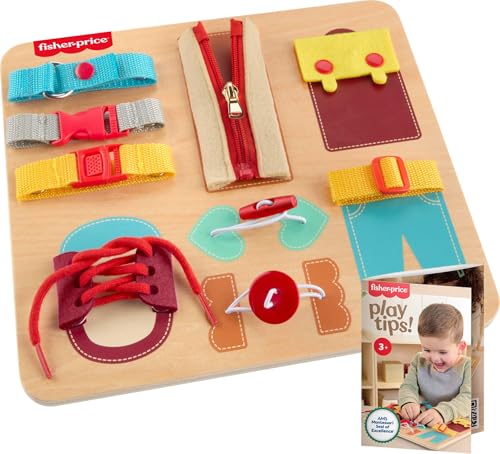 AMSA-endorsed wooden busy board aligned with Montessori practical life learning principles
This premium wooden board from trusted brand Fisher-Price carries the American Montessori Society Seal of Excellence, meaning it aligns with strict Montessori practical life learning guidelines. It features 6 realistic fasteners: a metal zipper, wooden buttons, a prong buckle, a snap, laces, and a shoe-tying station, all sized to mimic real clothing fasteners. The solid wood construction is durable enough for years of use, and the smooth, non-toxic finish meets all CPSIA safety standards. It’s best for 3 to 5 year olds who are ready to practice more advanced dressing skills in preparation for kindergarten.
AMSA-endorsed wooden busy board aligned with Montessori practical life learning principles
This premium wooden board from trusted brand Fisher-Price carries the American Montessori Society Seal of Excellence, meaning it aligns with strict Montessori practical life learning guidelines. It features 6 realistic fasteners: a metal zipper, wooden buttons, a prong buckle, a snap, laces, and a shoe-tying station, all sized to mimic real clothing fasteners. The solid wood construction is durable enough for years of use, and the smooth, non-toxic finish meets all CPSIA safety standards. It’s best for 3 to 5 year olds who are ready to practice more advanced dressing skills in preparation for kindergarten.
- Pros: AMSA-endorsed, realistic fasteners, durable wood construction
- Cons: Higher price point, smaller size may be challenging for children with larger hands For parents seeking a premium, educationally endorsed option to build advanced dressing skills in preschoolers, this Fisher-Price Montessori board is a long-lasting investment.
7. WoodenEdu Montessori Busy Board
 Sturdy wooden sensory board with varied interactive elements for extended play
This unique wooden board goes beyond standard fasteners to include interactive elements like a working lock, light switch, and door latch, in addition to a zipper, buckle, snap, and button. The varied activities keep toddlers engaged for longer play sessions, and the solid wood construction holds up to rough handling. It’s a great pick for toddlers who get bored easily with standard busy boards, as the extra activities provide new challenges as they master basic fasteners. It pairs well with other sensory play tools to support holistic early learning, and at 12 x 9 x 1 inch, it’s compact enough for travel but sturdy enough for daily home use.
Sturdy wooden sensory board with varied interactive elements for extended play
This unique wooden board goes beyond standard fasteners to include interactive elements like a working lock, light switch, and door latch, in addition to a zipper, buckle, snap, and button. The varied activities keep toddlers engaged for longer play sessions, and the solid wood construction holds up to rough handling. It’s a great pick for toddlers who get bored easily with standard busy boards, as the extra activities provide new challenges as they master basic fasteners. It pairs well with other sensory play tools to support holistic early learning, and at 12 x 9 x 1 inch, it’s compact enough for travel but sturdy enough for daily home use.
- Pros: Varied interactive activities beyond fasteners, durable wood construction, Montessori-aligned
- Cons: Lock and switch components may be confusing for younger toddlers, higher price point than basic boards For toddlers who need varied challenges to stay engaged, this multi-activity wooden busy board builds fine motor skills while supporting cognitive development through problem-solving play.
8. Buckle Toys Blue Foam Busy Board
 Soft foam board safe for young toddlers to manipulate independently
This soft foam board is designed for the youngest toddlers (12–24 months) who are still building grip strength and may drop or throw toys during play. It features 5 varied buckle types with easy-squeeze releases, no sharp edges, and a lightweight 0.35 pound construction that’s safe for independent play. The bright blue color is visually stimulating, and the soft foam base prevents injury if a toddler pulls it down on themselves. It’s a great pick for a first busy board for 1 year olds.
Soft foam board safe for young toddlers to manipulate independently
This soft foam board is designed for the youngest toddlers (12–24 months) who are still building grip strength and may drop or throw toys during play. It features 5 varied buckle types with easy-squeeze releases, no sharp edges, and a lightweight 0.35 pound construction that’s safe for independent play. The bright blue color is visually stimulating, and the soft foam base prevents injury if a toddler pulls it down on themselves. It’s a great pick for a first busy board for 1 year olds.
- Pros: Soft safe construction, easy-grip buckles, lightweight
- Cons: Limited to buckling practice, foam may tear with rough long-term use For a safe, soft first busy board for 1-year-old toddlers just starting to build fine motor skills, this blue foam option is a worry-free pick.
9. Buckle Toys Bella Square
 Compact single-activity busy board focused on buckling skill mastery
This compact square board is focused exclusively on buckling skill practice, with 3 different buckle types of varying difficulty levels. At 6.5 x 6.5 x 3 inches and 0.11 pounds, it’s small enough to fit in a coat pocket or small bag, making it ideal for quick errands. The bright pink color is appealing to many toddlers, and the simple, focused design prevents overwhelm for new learners. It’s best for toddlers 12–24 months who are just starting to practice buckling skills.
Compact single-activity busy board focused on buckling skill mastery
This compact square board is focused exclusively on buckling skill practice, with 3 different buckle types of varying difficulty levels. At 6.5 x 6.5 x 3 inches and 0.11 pounds, it’s small enough to fit in a coat pocket or small bag, making it ideal for quick errands. The bright pink color is appealing to many toddlers, and the simple, focused design prevents overwhelm for new learners. It’s best for toddlers 12–24 months who are just starting to practice buckling skills.
- Pros: Ultra-portable, focused skill building, affordable
- Cons: Limited to buckling practice, small size may be challenging for toddlers with less developed grip For a simple, affordable option to focus exclusively on buckling skill mastery for young toddlers, this compact Bella Square board is a convenient pick.
10. Buckle Toys Pink Foam Busy Board
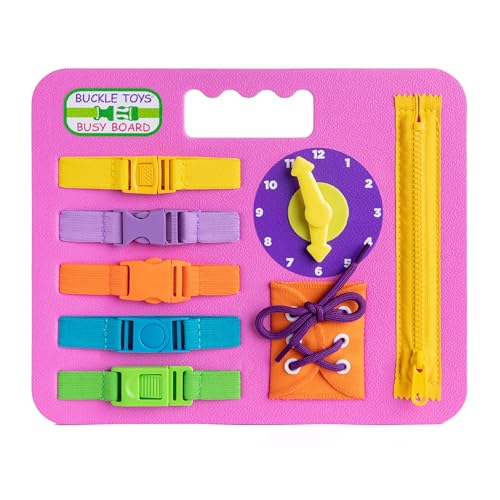 Lightweight soft busy board ideal for travel and on-the-go learning
This soft foam busy board is a versatile pick for 1 to 3 year old toddlers, featuring 4 buckle types, a small zipper, and a lacing practice station. At 9 x 11 x 1 inch and 0.33 pounds, it’s lightweight enough for travel, and the soft foam construction is safe for independent play. The bright pink color is visually stimulating, and the varied fasteners provide progressive skill challenges as your toddler grows. For families who want a compact entertainment option for daily outings, a compact stroller attachment pairs perfectly with this board for long walks or trips.
Lightweight soft busy board ideal for travel and on-the-go learning
This soft foam busy board is a versatile pick for 1 to 3 year old toddlers, featuring 4 buckle types, a small zipper, and a lacing practice station. At 9 x 11 x 1 inch and 0.33 pounds, it’s lightweight enough for travel, and the soft foam construction is safe for independent play. The bright pink color is visually stimulating, and the varied fasteners provide progressive skill challenges as your toddler grows. For families who want a compact entertainment option for daily outings, a compact stroller attachment pairs perfectly with this board for long walks or trips.
- Pros: Varied fasteners, soft safe construction, lightweight
- Cons: Limited color options, may not challenge older toddlers beyond 3 years For a versatile, soft busy board that grows with your toddler from 1 to 3 years old, this pink foam option offers consistent skill-building opportunities for home and travel.
Tips to Maximize Skill Building With Zipper Buckle Busy Boards
To get the most out of your busy board and help your toddler master fasteners faster, follow these evidence-based tips from early childhood educators:
- Start with one fastener at a time: Don’t overwhelm your toddler with a board full of fasteners at first. Practice one skill (e.g., buckling) for a few days before introducing a new one (e.g., zipping) to build confidence and avoid frustration.
- Use verbal cues: Name each part of the fastener as you demonstrate (e.g., “This is the zipper pull, we pinch it and pull up”) to build language skills alongside motor skills.
- Practice during low-stress times: Use the busy board during quiet time, car rides, or while waiting for food at a restaurant, not when you’re in a rush to get dressed, to keep play positive and pressure-free.
- Celebrate small wins: Praise your toddler for every small success, even if they only pull the zipper up an inch, to build confidence and encourage continued practice.
- Rotate toys: If your toddler loses interest in the busy board after a few weeks, put it away for a month and bring it back out to re-engage their interest and extend its usable lifespan.
Frequently Asked Questions
What specific fine motor skills do zipper and buckle busy boards target?
These boards target four core fine motor skill areas critical for toddler development: 1) Pincer grasp strength (pinching zipper pulls and buckle tabs), 2) Bilateral coordination (using both hands to guide a zipper track or squeeze a buckle release), 3) Finger dexterity (twisting, pulling, and pressing small fasteners), and 4) Hand-eye coordination (aligning a buckle prong with a hole or guiding a zipper along its track). Repetitive practice of these actions builds the muscle memory needed for tasks like buttoning shirts, tying shoes, and holding writing utensils, making them a valuable pre-writing tool as well.
At what age can toddlers start using zipper buckle busy boards?
Most children are ready for simple busy boards with large, easy-to-grasp fasteners between 12 and 18 months, when they can sit independently and manipulate small objects. More complex boards with multiple small fasteners and shoe-tying practice stations are best for 18 to 36 month olds, who have the dexterity to handle smaller components and can follow simple step-by-step tasks.
Are busy boards safe for toddlers who still mouth objects?
Yes, if you choose a board certified to meet ASTM F963 safety standards, which require all components to be securely attached (no detachable small parts that pose choking hazards) and made from non-toxic, BPA-free materials. Always supervise toddlers under 18 months during play, and inspect the board regularly for loose parts or wear and tear.
How do busy boards support independent dressing?
Busy boards let toddlers practice dressing skills in a low-pressure, error-free environment, unlike real clothing which can be stiff, too small, or cause frustration when a toddler can’t fasten it quickly. Regular practice builds the muscle memory and confidence needed to complete dressing tasks independently, reducing dressing-related tantrums and building self-reliance.
Can busy boards be used for travel?
Absolutely. Most zipper buckle busy boards are designed to be compact and lightweight, fitting easily into diaper bags, car seat organizers, or even coat pockets. They provide a screen-free way to keep toddlers engaged during road trips, flights, or waiting room visits, reducing boredom and meltdowns while building skills on the go.
How often should toddlers use a busy board to see improvement?
Short, daily 5–10 minute sessions are far more effective than longer, infrequent playtimes. Most toddlers show noticeable improvement in fastener manipulation within 3 to 6 months of regular use, with full mastery of basic zippers and buckles taking up to a year depending on their individual developmental pace.
Final Thoughts
Zipper and buckle busy boards are a low-cost, low-pressure tool to build critical fine motor skills that support lifelong independence. By choosing a board that matches your toddler’s age, skill level, and lifestyle (home use vs. travel), you can provide consistent, fun practice that reduces dressing frustration and builds confidence. Whether you opt for a compact travel board or a multi-activity Montessori option, regular play with these tools will help your toddler master essential life skills while having fun. For more screen-free toy ideas to support your toddler’s development, explore our guides to sensory play tools and age-appropriate developmental toys.
Sophia Linda is a freelance writer and Certified Health Coach based in the Newbury Park, CA. Passionate about healthy living, she focuses on helping families stay active and connected to the outdoors. Together with her husband and their three young children, Sophia spends much of her time traveling, hiking, and camping. Her work has been featured on the bestbabycart blog, and she brings a practical, real-world perspective to reviewing baby products for parents.