
Baby Monitor Every parent wants a safe night’s sleep while keeping one eye on their baby. Baby monitors promise peace of mind. But many parents worry about radiation from these devices. This guide breaks that worry down into clear facts. You will learn what radiation and EMF mean, how baby monitors send signals, and how much radiation they actually emit. You will also find practical steps to lower exposure and pick safer models. This article uses plain language and trusted sources like the World Health Organization (WHO) and the Federal Communications Commission (FCC). It aims to make infant safety, wireless devices, and baby technology easy to understand. Read on to feel informed and calm.

Introduction – Why Parents Worry About Baby Monitor Radiation
Many parents fear anything labeled “radiation.” The word sounds dangerous. Parents also hear about EMF and long-term risks. Babies feel more fragile, and parents want to protect their brains and bodies.
Wireless baby monitors are now common. Wi‑Fi video monitors stream 24/7. Cloud features and apps keep parents connected from anywhere. This growth raises questions about EMF exposure and infant brains.
Medical groups and governments give mixed messages. Some say low levels are safe. Others recommend caution for infants. Parents want simple guidance they can trust.
This guide explains the science in plain words. It covers types of signals, real exposure levels, safety tips, and best monitor choices. You will get practical steps to reduce risk.

What Radiation Means in Baby Monitors
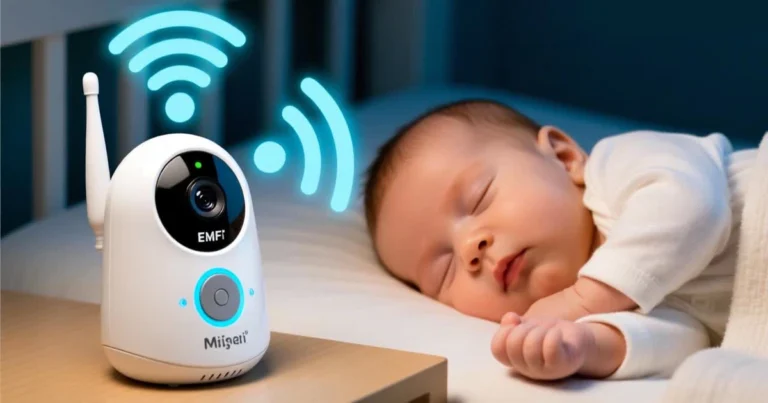
Baby monitors use radio frequency (RF) energy to send sound and video. RF is a type of electromagnetic field (EMF). It moves data through the air without wires.
EMF is a broad term. It covers electric fields, magnetic fields, and radio waves. Many household devices make EMF, such as routers, phones, and microwaves. EMF from monitors is usually non‑ionizing.
Non‑ionizing radiation does not remove electrons from atoms. It does not cause the DNA breaks linked to cancer in the way ionizing radiation can. Baby monitors and Wi‑Fi use non‑ionizing radio waves. Still, long‑term low‑level exposure is a topic of ongoing research.

What EMF radiation actually is
EMF stands for electromagnetic fields. It includes a spectrum from very low frequency up to gamma rays. Radio waves used in baby monitors sit near the low‑energy end.
These waves carry information. The monitor’s transmitter creates an oscillating electric and magnetic field. A receiver captures that field and converts it back to sound or image. The strength of this field drops quickly with distance.

Difference between ionizing and non-ionizing radiation
Ionizing radiation, like X‑rays, can break chemical bonds. It can damage DNA and raise cancer risk. Non‑ionizing radiation, like radio waves, lacks that energy.
Most concerns about baby monitors focus on non‑ionizing RF energy. Scientists study whether long‑term low exposure affects health. So far, major agencies do not classify low‑level RF from monitors as proven harmful. They do suggest caution, especially for infants.

Why baby monitors use radio waves
Radio waves travel through walls and air. They are efficient for home use. Monitors use radio signals because they are low power and reliable.
Different technologies use different methods. Some use local wireless links. Others use home Wi‑Fi and the internet. Each method has tradeoffs in range, clarity, and privacy.

How data is transmitted
Monitors convert sound and video into digital data. The transmitter modulates radio waves to carry that data. The receiver demodulates the signal and plays sound or displays video.
Wi‑Fi monitors often stream compressed video to a router and then the cloud. DECT and FHSS systems send directly between parent unit and baby unit. Each method affects power use and exposure.
Types of Baby Monitor Signals
Baby monitors use several signaling methods. The main types are Wi‑Fi, DECT, FHSS, and analog RF. Each uses different frequencies and power levels.
Parents should know the basics to choose safer options. This section explains what each type means. It also covers power levels, frequency ranges, and signal strength.

Wi‑Fi baby monitors
Wi‑Fi monitors use your home network to stream video and audio. They connect to a router and often to cloud servers. This allows remote viewing from smartphones.
Wi‑Fi units usually operate at 2.4 GHz or 5 GHz. They can transmit continuously while streaming video. That means a steady RF field in the nursery while the camera is on.

DECT baby monitors
DECT stands for Digital Enhanced Cordless Telecommunications. It is a standard used by many home phones and some baby monitors. DECT operates around 1.9 GHz in most countries.
DECT tends to use bursts of signal rather than continuous streaming. It was designed for low‑power, reliable voice links. Many consider DECT safer than always‑on Wi‑Fi video in terms of average RF exposure.
FHSS baby monitors
FHSS means Frequency Hopping Spread Spectrum. It sends short bursts over many frequencies in sequence. The signal “hops” quickly across the band.
FHSS reduces the chance of sustained high exposure at one frequency. It also makes eavesdropping harder. Many modern non‑Wi‑Fi video monitors use FHSS to balance range and security.
Analog RF monitors
Older monitors use analog RF signals. They operate in several frequency bands, like 49 MHz, 900 MHz, or 2.4 GHz. Analog systems can be simpler but often lack encryption.
Analog RF may have variable power levels and can be noisy. They do not usually stream video to the cloud. Their signal can be weaker and less efficient than digital systems.
Power levels, frequency ranges, and signal strength
Transmit power is usually measured in milliwatts (mW). Baby monitors often use low mW outputs. Frequency bands vary: 900 MHz, 1.9 GHz (DECT), 2.4 GHz, and 5 GHz.
Signal strength and resulting exposure drop with distance. Doubling distance reduces exposure sharply. Walls and objects also lower signal power. Understanding these basics helps pick safer placement and models.
How Much Radiation Do Baby Monitors Emit?
Most baby monitors emit very low levels of RF energy. But levels vary by type and use. Video monitors that stream continuously will show higher exposure than audio models that transmit intermittently.
To make sense of numbers, compare baby monitors to other devices. Smartphones, Wi‑Fi routers, and Bluetooth all emit RF energy. Baby monitors usually generate less RF than a phone held to the ear. Still, placement and time on matter.
Here are rough comparisons and real‑world context. This helps parents see where monitors sit on the EMF scale.
How baby monitors compare to smartphones
Smartphones can emit power levels near 100 mW during calls and higher in some situations. They sit right next to the head when used. That proximity means higher absorption.
Baby monitors are usually further from a baby than a phone is from an adult’s head. Even so, an always‑on Wi‑Fi camera close to a crib can exceed a phone at a distance. Overall, a typical monitor emits less RF energy than an active smartphone held directly against the skin.
How baby monitors compare to Wi‑Fi routers
Wi‑Fi routers may transmit at similar power levels to Wi‑Fi monitors. Routers often sit in living rooms and run 24/7. A baby monitor near a crib acts like a local router in the room.
If a Wi‑Fi camera connects to your router, the combined EMF in the nursery can be higher. But routers are generally placed farther away from a baby than a dedicated camera mounted too close. Consider both devices when measuring exposure.
How baby monitors compare to Bluetooth devices
Bluetooth devices use very low power. They operate around 2.4 GHz like Wi‑Fi but at lower output. Bluetooth is often intermittent and short range.
A Bluetooth baby device or sensor typically emits less RF than Wi‑Fi video. If low exposure is the main goal, Bluetooth options for simple sensors can be a good choice.
Why distance matters
RF energy follows the inverse-square law. Double the distance, and the power density falls to one‑quarter. This simple rule makes placement critical.
A camera 1 foot from a crib will expose the baby to much more RF than the same device 6 feet away. Small changes in placement yield big changes in exposure. This is an easy and powerful step to reduce risk.
Why video monitors emit more than audio
Video requires constant high‑bandwidth data. This means continuous transmission and often higher power use. Audio-only monitors send intermittent, smaller packets of data.
Hence, video monitors generally emit more RF energy over time. Choosing audio over video greatly cuts average exposure.
Are Babies More Sensitive to Radiation?
Infants can absorb more RF energy relative to their body size. Their skulls are thinner and tissues more conductive. This leads to higher specific absorption rate (SAR) for some exposures.
Young brains are still developing. Scientists worry that developing tissues might be more vulnerable to environmental stressors. For this reason, many pediatric experts suggest a precautionary approach.
Why infant brains absorb more radiation
A baby’s head is smaller and contains more water and conductive tissue. These features change how RF fields penetrate and deposit energy. Models show higher absorption in infants under certain conditions.
Absorption depends on frequency and distance. Lower frequency fields behave differently than higher ones. This is why many experts recommend keeping devices well away from the crib.
Thinner skulls
Adults have thicker skull bones that offer more shielding. Infants’ skulls are thinner and more porous. This reduces protection against RF penetration.
Even at low levels, the relative energy absorbed by infant tissue can be higher. Small changes in distance have larger effects on the dose a baby receives compared to an adult.
Developing nervous systems
Neurons form critical connections in early months and years. Disruption to this process can have long‑term effects in theory. However, clear evidence linking low‑level RF exposure to developmental harm is lacking.
Because the research is still evolving, many pediatric bodies advise caution until more is known. This often means limiting unnecessary exposure rather than banning useful devices.
Why pediatric experts urge caution
Groups like the American Academy of Pediatrics (AAP) and WHO note uncertainty. They recommend common‑sense steps to reduce exposure to wireless devices for children. These steps include distance, limiting duration, and favoring lower‑power tech.
The advice is precautionary. It balances current evidence with the principle of doing no harm. Many parents find this approach reasonable and actionable.
Wi-Fi Baby Monitor Radiation Risks
Wi‑Fi cameras bring convenience. They also bring continuous RF transmission when streaming. That always‑on state can create higher average EMF levels in the nursery.
Cloud cameras send data beyond the home. This raises security and privacy concerns too. Worse, a camera that streams all night can increase cumulative exposure for a baby.
Continuous data streaming
Continuous streaming means the transmitter is active nearly nonstop. This keeps the radio on at steady power. Over hours and nights, exposure adds up.
Even when no one watches live, many cameras keep the link open. Some only upload motion clips, but many keep a constant handshake with the router. Monitoring settings matter a lot.
Cloud-connected cameras
Cloud features add convenience and updates. But they also involve remote servers and internet links. This can require higher and more frequent data bursts.
Some companies store video offsite. This is great for backups but keeps the camera active. You can reduce exposure by using local recording options when possible.
Always-on radio transmitters
An always‑on transmitter creates a steady RF field. This contrasts with audio monitors that send only on sound or with FHSS/DECT that use bursts. For parents focused on low radiation, always‑on Wi‑Fi cams are the top area to manage.
Entity examples: Nanit, Miku, Google Nest Cam
Popular Wi‑Fi camera brands include Nanit, Miku, and Nest. They offer features like breathing tracking, sleep analytics, and cloud recording. These features often require continual or frequent data transmission.
If you use such a camera, review power and privacy settings. Some models allow scheduled off times or local mode. Turning off cameras overnight or using airplane mode when not needed reduces exposure.
Audio Baby Monitor Radiation Levels
Audio monitors generally use less data and power than video. They may transmit only when sound is detected or at low duty cycles. This makes them a lower‑radiation choice for many parents.
Simpler audio units with direct parent‑unit links often avoid home Wi‑Fi and the internet. That reduces both RF exposure and privacy risk. If baby tracking is the main need, audio can be effective and safer.
Lower transmission power
Audio signals require less bandwidth. Many audio units use low transmit power. This leads to lower average RF energy in the room.
Some audio units are battery powered and send bursts only when sound occurs. That minimizes active transmit time and exposure.
No video data
Without images, data volume is much smaller. This means shorter transmissions and reduced continuous load. The drop in data needs directly reduces RF emissions.
For parents who mostly want sound and cry alerts, audio-only options make sense. They balance function with lower exposure.
Intermittent signals
Sound-activated monitors sleep until noise is detected. This intermittent pattern cuts cumulative exposure. It can also save battery life if the baby is quiet for long stretches.
The downside is a slight delay or missed soft sounds depending on sensitivity. You can test units to find reliable models.
Entity examples: VTech Safe & Sound, Philips Avent, Angelcare
Brands like VTech Safe & Sound, Philips Avent, and Angelcare offer trusted audio models. Some Angelcare units also include movement sensors that are non‑RF. These brands provide options for parents wanting lower‑radiation monitoring.
Check if units use FHSS or DECT for even lower average exposure. Read specs and user manuals to confirm transmission behavior.
DECT and FHSS Technology Explained
Understanding DECT and FHSS helps parents choose lower‑emission monitors. Both techniques cut average RF exposure in different ways.
They also provide privacy benefits. This section explains how each one works and why pediatric tech experts often prefer them.
What DECT is
DECT is a digital wireless standard used for cordless phones. It uses 1.9 GHz in many countries. DECT operates in bursts and has effective power control.
Modern DECT monitors transmit voice clearly with relatively low average power. They often use less energy than Wi‑Fi cameras and are a popular choice for audio monitoring.
What FHSS is
FHSS jumps the signal across many frequencies in quick succession. Each hop is short and spread out. The net result is lower continuous exposure at any one frequency.
FHSS also reduces interference and makes eavesdropping harder. For video, FHSS helps balance quality with lower sustained RF. Many practical parental tech choices use FHSS for secure links.
Why they reduce radiation
Both methods lower the duty cycle of a transmitter. Lower duty cycle means shorter active times or spread energy across many frequencies. This reduces average exposure.
They also can operate with power control. That means the transmitter only uses as much power as needed. When combined with distance, this creates a lower overall dose for babies.
Why pediatric tech experts prefer them
Experts often suggest DECT or FHSS because they balance clarity with lower exposure and better privacy. These technologies do not require home internet to work. They keep data local to the parent and baby units.
For parents worried about both radiation and hacking, DECT and FHSS are sensible defaults. They provide reliable monitoring without the constant RF field of a Wi‑Fi camera.
Safe Distance Guidelines
Distance is the most effective lever parents control. A small change in placement can cut exposure dramatically. Many agencies give practical distance guidance.
This section lists recommended minimum distances and explains why cameras and transmitters should not be mounted too close.
Why radiation drops with distance
RF intensity decreases rapidly with distance. This happens because the same energy spreads over a larger area. Think of a flashlight beam getting dimmer as you step back.
The inverse-square rule means that small moves are powerful. Move a camera a few feet away and exposure falls a lot. This simple step is often the most effective.
Minimum safe placement from crib
A common practical rule is to place any transmitter at least 3 feet (about 1 meter) from the baby. More distance is better. If the monitor is a Wi‑Fi camera, 6 feet or more is preferable when possible.
If you must have a camera on the crib wall, choose a low‑power model and use scheduled off times. Avoid mounting devices directly over or beside the baby’s head.
Why never to mount cameras too close
Mounting a camera inches from a crib maximizes exposure. It also increases the chance of physical hazards like cords or collapse. Close placement can raise SAR absorption in the infant’s head.
Safety rules recommend keeping electronics and cords out of reach as a separate, important step. Distance helps both radiation and physical safety.
Entity guidance: CPSC and AAP
The U.S. Consumer Product Safety Commission (CPSC) and the American Academy of Pediatrics (AAP) emphasize physical safety and safe sleeping. While they don’t set strict RF distance rules, both recommend keeping electronic devices and hazards away from cribs.
Follow their broad safety advice and add distance for EMF reduction. Together, these tips protect both body and brain.
How to Reduce Baby Monitor Radiation
Practical steps can lower exposure without losing peace of mind. Many are simple to apply. Here is a checklist parents can use today.
-
Choose audio-only when you can. Audio monitors use less data and power.
-
Prefer DECT or FHSS systems over Wi‑Fi for local links. They have lower duty cycles.
-
Turn off Wi‑Fi cameras when not needed. Use scheduled off times at night if you don’t need live video.
-
Place the monitor as far from the crib as practical. A few extra feet makes a big difference.
-
Use night-only activation and sound‑triggered recording. This cuts continuous transmission.
-
Use wired alternatives when possible. A wired baby monitor with a long cable removes RF concerns.
-
Disable cloud features or choose local storage. This reduces external data transfer and often lowers active transmission.
-
Use airplane mode or power off the unit during naps if monitoring is not needed. This reduces cumulative exposure.
-
Check device SAR and power specs in manuals before buying. Compare models for lower transmit power.
-
Consider using a simple movement pad or non‑RF sensor as a backup. Some movement monitors use no RF at all.
What Safety Agencies Say
Several major agencies provide useful context on RF exposure. Their statements help parents weigh risk and action. Below are key takeaways from leading bodies.
The Federal Communications Commission (FCC) sets limits on device RF emissions. These limits aim to avoid heating effects in humans. FCC rules apply to marketed devices and enforce maximum exposure values.
The World Health Organization (WHO) monitors research on EMF. WHO says there is no conclusive evidence linking low‑level RF exposure to health problems. Still, WHO encourages research and a precautionary approach for children.
The American Academy of Pediatrics (AAP) recommends prudent avoidance. AAP suggests lowering exposure by reducing duration and increasing distance from wireless devices in children. These organizations do not ban baby monitors but ask for common-sense steps.
FCC radiation limits
The FCC set SAR limits for devices sold in the U.S. These limits are designed to prevent thermal harm. Baby monitors typically operate well under these limits. Compliance means devices meet tested standards for power emissions.
Note that SAR tests often use adult models. Critics argue infant exposure differs. This is why distance and lower-power choices remain practical for parents.
WHO health statements
WHO’s International Agency for Research on Cancer (IARC) classed RF as “possibly carcinogenic” (Group 2B) in 2011. This means limited evidence of risk in humans. WHO continues to fund and review research on RF and child health.
WHO emphasizes that current evidence is not conclusive. The organization supports precautionary measures, especially for children.
Pediatric safety advice
Pediatric groups advise being cautious with infant exposure. The AAP suggests that parents limit unnecessary use of wireless devices near children. They also promote distance and alternative non‑wireless options when feasible.
These groups aim to protect developing brains while keeping beneficial technology available. Their stance is balanced and practical.
Best Low-Radiation Baby Monitors
Choosing the right monitor involves tradeoffs. You want safety, reliability, and budget sense. Here are recommended categories and sample models to consider.
-
Best audio monitors: Look for DECT or low‑power analog audio units. They have long battery life and low duty cycles. Models from VTech and Philips Avent are often cited for durable audio performance.
-
Best FHSS video monitors: Choose FHSS if you want video without constant Wi‑Fi. These models limit continuous exposure and boost privacy. Brands that offer FHSS or local livestreaming without cloud can be strong choices.
-
Best DECT monitors: DECT units provide clear audio with low average power. Many parents like DECT for voice‑only monitoring. Angelcare and other trusted brands offer DECT models.
-
Best secure Wi‑Fi models with low exposure: Some Wi‑Fi cameras allow local recording, scheduled off times, and power throttling. If you need cloud features, look for models that let you disable continuous streaming. Nanit, Miku, and Google Nest Cam have configurable settings; verify local mode options.
Money + trust section:
-
Price matters. Low RF does not always mean expensive. Many audio models are budget friendly.
-
Brand reputation counts. Pick products from companies with good safety and privacy records. Look for FCC certification and transparent manuals.
-
Read reviews and check user forums. Real parents often share useful setup tips to reduce exposure.
Common Myths About Baby Monitor Radiation
There is a lot of misinformation online. Clearing myths helps parents make calm, factual choices.
-
Myth: All radiation is dangerous. Reality: Radiation covers many types. Non‑ionizing RF used by monitors is not the same as X‑rays. Risk depends on energy and dose.
-
Myth: Wi‑Fi is deadly. Reality: Wi‑Fi emits low‑energy non‑ionizing waves. Major agencies do not find conclusive proof of harm at household exposure levels. Still, moderation and distance make sense.
-
Myth: Audio has zero radiation. Reality: Audio monitors do emit RF, but usually much less than video and phones. Intermittent transmission cuts exposure further.
-
Myth: Distance doesn’t matter. Reality: Distance is the single most effective way to lower exposure. Moving a device back a few feet greatly reduces RF energy at the baby.
Conclusion
Baby monitors emit low-level, non-ionizing radiation. The amount depends on the type, power, and how you use the device. Wi‑Fi cameras that stream continuously produce higher average RF than audio or burst‑transmission systems.
Infants can absorb more RF than adults because of size and tissue differences. For that reason, pediatric experts and agencies recommend simple, practical steps: increase distance, prefer lower‑power technologies, and limit continuous streaming. These actions reduce exposure dramatically and keep the monitor’s benefits.
Smart choices—like audio-only models, DECT or FHSS systems, and turning off cameras when not needed—make baby monitoring safer. Use trusted brands, read specs, and follow safety guidance from the FCC, WHO, and AAP. With a few common-sense moves, you can protect infant safety while enjoying the peace of mind baby monitors provide.
Frequently Asked Questions
Do baby monitors cause cancer?
Current evidence does not show that low-level RF from household baby monitors causes cancer. The WHO classifies RF as “possibly carcinogenic” based on limited data. Most health agencies say more research is needed. The best practice is a precautionary one: reduce exposure by distance and device choice.
Is Wi‑Fi baby monitor radiation dangerous?
Wi‑Fi monitors can create higher average RF exposure than audio units because they often stream continuously. “Dangerous” is not a settled verdict for typical household levels. However, prudent avoidance—keeping distance, turning off when not in use, and favoring local recording—reduces potential risk.
Are audio baby monitors safer?
Generally, yes. Audio monitors use less data and lower transmission power. Sound-activated units and DECT models reduce continuous transmission and therefore lower average exposure.
How far should a baby monitor be from a baby?
Aim for at least 3 feet (1 meter) as a practical minimum. If you use a Wi‑Fi camera, consider 6 feet or more when possible. More distance leads to much lower exposure.
Which baby monitor emits the least radiation?
Simple, battery‑powered audio monitors and units using DECT or FHSS typically emit the least RF energy. Wired monitors and non‑RF movement sensors emit none. Always check manufacturer specs and choose models with low transmit power and intermittent transmission patterns.

Emma Grace is a devoted mother and passionate content writer at BestBabyCart.com. With firsthand parenting experience and a love for research, she creates helpful guides and honest reviews to support parents in choosing the best for their babies. Her goal is to make parenthood easier, one article at a time.