

Most new parents report significant sleep disruption in their baby’s first 18 months, and the cycle of frequent night wakings can leave everyone in the household exhausted and frazzled. Baby sleep training is not about forcing your child to “cry it out” or follow a rigid, one-size-fits-all schedule—it’s about teaching your little one to self-soothe and fall asleep independently, so everyone gets the rest they need to thrive. This guide breaks down current, evidence-based strategies aligned with 2026 pediatric guidance, including age-appropriate timing, method comparisons, environment tweaks, and troubleshooting for common roadblocks, to help you build a sleep routine that works for your family.
Why Sleep Training Matters for Babies and Parents
Sleep training does more than just reduce night wakings—it supports foundational development for your baby and improves well-being for every member of the household. You can also read our guide on frida baby potty training kit.
Benefits for Baby Development
A predictable sleep schedule anchors your baby’s developing circadian rhythm, reducing fussiness from overtiredness and supporting consistent rest cycles. Quality sleep is critical for physical growth, brain development, and emotional regulation: babies who get adequate, uninterrupted sleep are more alert during playtime, have stronger immune systems, and are less prone to meltdowns triggered by exhaustion. Establishing healthy sleep habits early also sets the stage for better sleep patterns throughout childhood and adolescence.
Benefits for Parental Well-Being
Even 1 to 2 extra hours of uninterrupted sleep per night can reduce parental stress, improve mood, and lower risk of postpartum depression, per long-term data from family health studies. When parents are well-rested, they are more patient, attentive, and able to bond meaningfully with their baby during awake hours. Sleep training also frees up time for self-care, household tasks, or connection with a partner, strengthening overall family dynamics. You can also read our guide on best nursery furniture deals.
 Printable cheat sheet summarizing core sleep training steps for quick reference
Credit: www.babysleepsite.com
Printable cheat sheet summarizing core sleep training steps for quick reference
Credit: www.babysleepsite.com
When to Start Sleep Training: Age and Readiness Signs
Timing is one of the biggest factors in sleep training success. Starting too early can lead to frustration for both you and your baby, while waiting too long can make entrenched sleep habits harder to break.
Current Age Guidelines for 2026
Most full-term, healthy babies are developmentally ready to start sleep training between 4 and 6 months of age. At this stage, most babies have consolidated their sleep cycles, no longer need night feedings for nutrition (pediatricians confirm most full-term infants can go 6 to 8 hours without feeding by this point), and have begun developing early self-soothing skills like sucking their hands or holding a small comfort object. Preterm babies should wait until their adjusted age reaches 4 months to account for their earlier birth. Babies older than 6 months can still be sleep trained successfully, though long-held sleep associations may take 2 to 3 weeks to adjust instead of the typical 3 to 7 days for younger infants. You can also read our guide on baby stroller sitting tips expert guidelines.
Concrete Readiness Cues to Watch For
Not all babies hit milestones at the exact same age, so watch for these concrete signs your little one is ready for independent sleep:
- Can roll both ways independently (a key safety milestone for crib sleep)
- Takes consistent, age-appropriate nap windows without extreme overtiredness
- Wakes only 1 to 2 times per night and easily settles back down without feeding
- Shows early self-soothing behaviors, like sucking fingers or calming down with a quick pat on the back
If your baby is sick, teething heavily, or going through a major life change (like a move or new sibling), wait to start sleep training until they feel secure and healthy again.
Top Evidence-Based Sleep Training Methods
No single sleep training method works for every family, so it’s important to pick an approach that aligns with your parenting style and your baby’s temperament. Below are the most widely recommended, research-backed methods used by pediatricians and sleep consultants in 2026. You can also read our guide on can you wash car seat covers.
Graduated Extinction (The Ferber Method)
This structured approach involves placing your baby in their crib awake, then checking on them at increasing intervals if they cry, without picking them up or turning on lights. Intervals typically start at 3 minutes, then increase to 5, then 10 minutes, with each check lasting no longer than 1 to 2 minutes. The goal is to teach your baby to self-soothe between checks, rather than relying on parental presence to fall asleep.
- Pros: Works quickly for many families, with most babies sleeping through the night within 3 to 5 nights.
- Cons: Can be stressful for highly sensitive babies or parents who struggle with hearing their child cry.
- Best for: Babies 6 months and older who have developed clear sleep associations and parents who prefer a structured, time-bound approach.
No-Tears Attachment-Friendly Approach
This gentle, gradual method focuses on fading parental involvement in the sleep process over 2 to 4 weeks, rather than leaving your baby to cry alone. For example, if you usually rock your baby to sleep, reduce rocking time by 1 minute each night until you are no longer needed at all. You can also gradually move your chair further away from the crib each night until you are no longer in the room at bedtime.
- Pros: Low stress for both baby and parents, strengthens bonding, and avoids prolonged crying.
- Cons: Takes longer to see full results than structured extinction methods.
- Best for: Highly sensitive babies, parents who prioritize gentle transitions, and families who want to avoid any crying at bedtime.
The Chair Method
This approach is ideal for babies with separation anxiety: sit in a chair next to your baby’s crib until they fall asleep, then move the chair a few feet further away from the crib each night until you are no longer in the room at bedtime. You can offer verbal reassurance or a quick pat on the back, but avoid picking your baby up or engaging in play.
- Pros: Reduces separation anxiety by keeping you in sight, minimal crying for most babies.
- Cons: Can take 3 to 4 weeks to fully implement, and some babies may become distressed if you move the chair too quickly.
- Best for: Babies 8 months and older who show signs of separation anxiety at bedtime.
Pick-Up/Put-Down Method
This gentle technique is best for younger babies (4 to 5 months) who have not yet developed strong sleep associations. When your baby cries, pick them up to comfort them until they are calm, then put them back in the crib awake. Repeat this process as many times as needed until they fall asleep on their own. Over time, your baby will learn that the crib is a safe, comfortable space to sleep.
- Pros: Very low stress, no prolonged crying, works well for young babies.
- Cons: Can take 4 to 6 weeks to see results, and may be physically tiring for parents of heavy babies.
- Best for: Babies under 6 months who have not yet learned to fall asleep independently.
A common mistake parents make is switching between methods after 2 to 3 nights of no progress, which can confuse babies and delay results. Commit to one method for at least 2 weeks before deciding to adjust your approach.
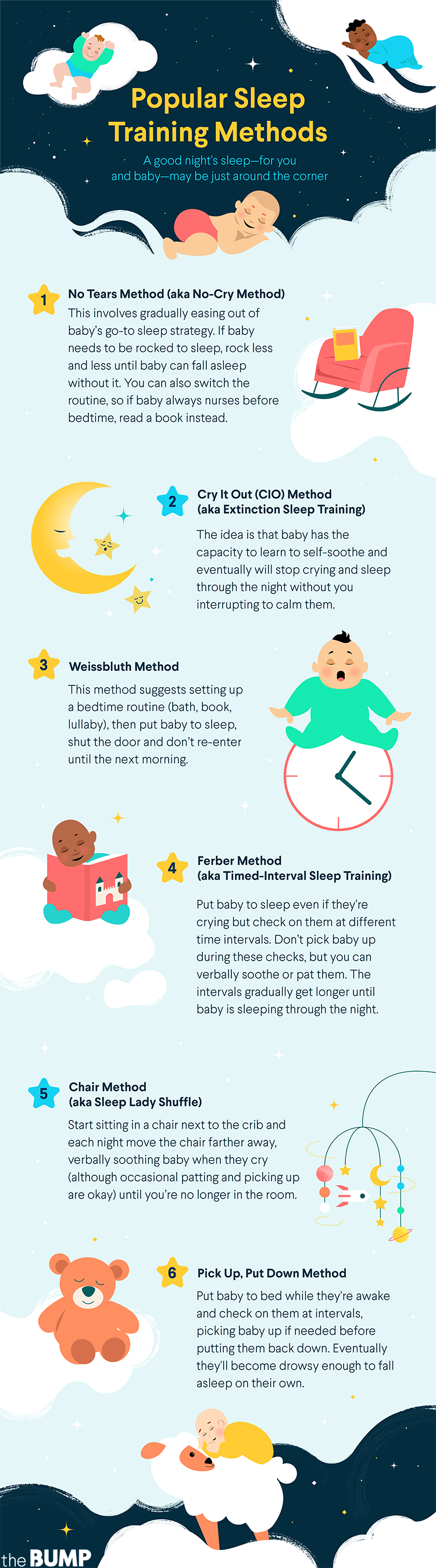 Side-by-side comparison of Ferber, no-tears, chair, and pick-up/put-down methods
Credit: www.thebump.com
Side-by-side comparison of Ferber, no-tears, chair, and pick-up/put-down methods
Credit: www.thebump.com
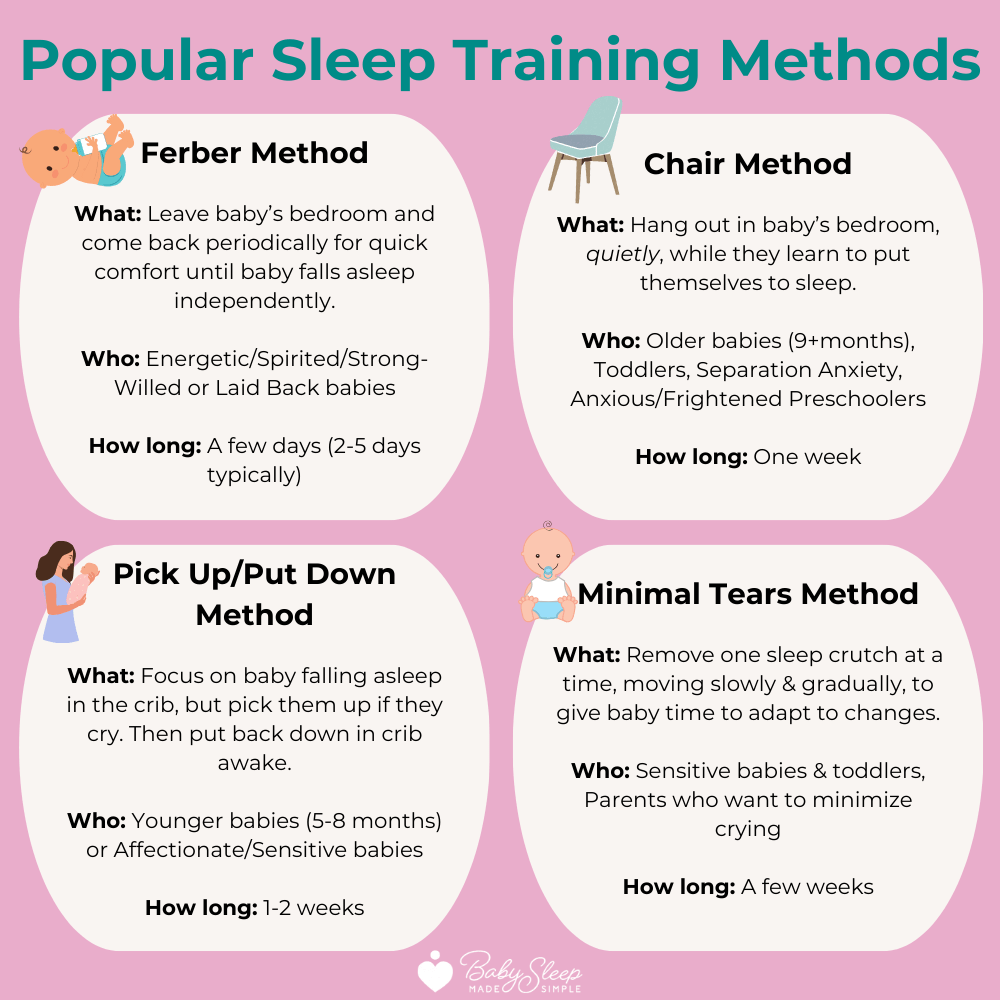 Step-by-step visual guide to the pick-up/put-down sleep training method
Credit: www.babysleepmadesimple.com
Step-by-step visual guide to the pick-up/put-down sleep training method
Credit: www.babysleepmadesimple.com
Designing a Sleep-Conducive Nursery Environment
Your baby’s sleep space plays a huge role in how quickly they settle and stay asleep. Small tweaks to the room can make the difference between a 10-minute bedtime struggle and a peaceful, 5-minute routine.
Optimal Room Conditions Per AAP Guidelines
The American Academy of Pediatrics recommends the following room setup to support safe, restful sleep:
- Temperature: Keep the room between 68 and 72°F (20 to 22°C) to avoid overheating, a major SIDS risk factor.
- Lighting: Install light-blocking window coverings to eliminate 100% of external light during naps and nighttime sleep, which helps regulate your baby’s melatonin production. If you use a nightlight for nighttime checks, opt for a red or orange glow, which does not suppress melatonin the way blue or white light does.
- Noise: Keep the room as quiet as possible, but a white noise machine set to 50 to 60 decibels (about the volume of a quiet shower) placed at least 3 feet from the crib can mask disruptive household sounds like doorbells or siblings playing.
Safe, Approved Sleep Aids
Only use sleep aids that meet AAP safety standards:
- Pacifiers: Reduce SIDS risk and can help babies self-soothe; wait until breastfeeding is fully established (usually 3 to 4 weeks) before introducing a pacifier.
- Swaddles and sleep sacks: Swaddling mimics the security of the womb for babies who have not yet started rolling, but transition to a sleeved sleep sack as soon as your baby shows signs of rolling to avoid suffocation risk.
- Comfort objects: Small, safe loveys (no larger than the baby’s head) can be introduced once your baby is 12 months old to provide comfort at bedtime.
Common Environmental Mistakes to Avoid
Skip loose blankets, stuffed animals, crib bumpers, and pillows in the crib, as these increase suffocation and SIDS risk. Avoid placing the crib near windows, heaters, or air conditioners, which can create uncomfortable drafts or temperature swings.
Building a Consistent Bedtime Routine That Sticks
A predictable bedtime routine is one of the most powerful tools for sleep training success, as it signals to your baby that it is time to wind down and prepare for rest.
The Ideal 30-45 Minute Routine Timeline
Stick to the same bedtime every night, within 30 minutes of your usual time (even on weekends, to avoid disrupting your baby’s circadian rhythm). Your routine should follow the same order every night, with the final step happening in the nursery to associate the space with sleep. A sample routine might look like:
- Warm bath (5-10 minutes)
- Lotion and pajamas (5 minutes)
- Bedtime story or lullaby (5-10 minutes)
- Final cuddle and goodnight (2-3 minutes)
- Place baby in the crib awake
Calming Transition Techniques
Incorporate these gentle techniques to help your baby shift from active play to restful sleep:
- Infant massage: 10 to 15 minutes of slow, gentle strokes on your baby’s back, arms, and legs can lower cortisol levels and promote relaxation.
- Mirror breathing: Hold your baby close and take slow, audible deep breaths; babies will naturally mirror your calm rhythm, helping them settle faster.
- Quiet play: Switch from high-energy activities like crawling or tickling to calm play like stacking blocks or reading 1 hour before bed to avoid overstimulation.
Routine Pitfalls to Avoid
Don’t add new, exciting activities (like a new toy or screen time) to the routine right before bed, as this will overstimulate your baby. If you are running late, skip a less important step (like the bath) rather than rearranging the order of your routine, as predictability is key to success. Opt for diapers with extra overnight absorbency to prevent disruptive wake-ups from wetness, a common but often overlooked roadblock to longer sleep stretches.
Daytime Habits That Support Nighttime Sleep
What happens during the day has a huge impact on how well your baby sleeps at night. These small, consistent habits can make bedtime far easier:
Age-Appropriate Nap Schedules
Overtiredness is one of the top causes of bedtime resistance and frequent night wakings. Follow these general nap guidelines to keep your baby well-rested:
- 0–3 months: 3 to 5 naps per day, 30 minutes to 2 hours each
- 4–6 months: 3 naps per day, 1 to 2 hours each
- 6–12 months: 2 naps per day, 1 to 2 hours each
- 12+ months: 1 nap per day, 1.5 to 3 hours
Ensure the last nap of the day ends at least 3 hours before bedtime to avoid sending your baby to bed overtired.
Balancing Active and Calm Play
Aim for 1 to 2 hours of supervised active play (tummy time, crawling, outdoor stroller walks) in the morning and early afternoon to help your baby build the physical fatigue needed for restful sleep. Switch to calm, low-stimulation activities like reading, soft music, or sensory play 1 hour before bed to help them wind down.
Daytime Feeding to Reduce Night Wakings
Ensure your baby gets enough calories during the day so they do not wake from hunger at night. For babies over 6 months, offer a small, iron-rich snack (like oatmeal or pureed fruit) before bed if they are still waking hungry. Avoid relying on feeding to sleep as a primary sleep association, as this can lead to babies expecting to eat every time they wake up at night. If you currently feed your baby to sleep, gradually reduce feeding time by 1 to 2 minutes each night to break the association. Ensure your baby’s crib has a safe crib setup free of loose blankets, stuffed animals, and bumpers to reduce SIDS risk and avoid distractions during sleep.
Troubleshooting Common Sleep Training Roadblocks
Even with a solid plan, you will likely hit bumps in the road. These are the most common challenges parents face, and how to address them:
Night Wakings: How to Respond Without Reinforcing Habits
If your baby wakes in the middle of the night, wait 1 to 2 minutes before intervening to see if they resettle on their own. If they do not, keep interactions as boring as possible: no talking, no lights, just a quick pat on the back or soft shush. Avoid picking them up unless they are sick or clearly distressed, as this will reinforce the expectation that waking up leads to attention. If your baby is waking out of habit rather than hunger, gradually reduce nighttime feedings by cutting feeding time by 1 to 2 minutes each night until they no longer expect to eat.
Managing Separation Anxiety at Bedtime
Separation anxiety typically peaks around 8 to 10 months and again at 18 months, making it hard for babies to settle alone. Use a small, safe comfort object (like a soft lovey or small blanket) during awake hours so it becomes familiar for bedtime. Stay consistent with your routine, and avoid sneaking out of the room—say a quick, cheerful goodbye so your baby learns you always come back. Your calm, confident demeanor will help ease their anxiety over time.
Navigating Sleep Regressions
Sleep regressions are temporary disruptions to sleep patterns that commonly occur at 4 months, 8 to 10 months, 12 months, 18 months, and 2 years, usually lasting 1 to 3 weeks. They are typically triggered by developmental milestones (like crawling or talking) or changes in routine. Stick to your usual sleep routine as much as possible, and avoid creating new sleep associations (like rocking to sleep) during the regression, as these can extend the disruption.
When to Pause Sleep Training
If your baby is sick, teething heavily, or going through a major stressful event (like a move or the arrival of a new sibling), pause sleep training until they feel secure and healthy again. Pausing will not undo progress you have already made, and pushing through a stressful period will only lead to more frustration for everyone.
Have you navigated sleep training with your little one? Share your go-to tips and lessons learned in the comments to help fellow parents feel less alone on their journey.
Expert Guidance and Safety Reminders for 2026
Current guidance from the American Academy of Pediatrics confirms that consistent, responsive sleep training is safe for full-term, healthy babies when paired with evidence-based safe sleep practices, and there is no credible research linking age-appropriate sleep training to long-term emotional harm. Always consult your pediatrician before starting sleep training if your baby has underlying health conditions, reflux, or was born prematurely, to ensure the approach you choose is safe for their unique needs.
In practice, the biggest predictor of sleep training success is consistency: even if a night goes poorly, stick to your routine the next day, and progress will follow. It is normal for sleep to be non-linear during training—off nights are not a sign you are doing something wrong, just a normal part of the process.
Frequently Asked Questions
What is the 5-3-3 rule for sleep training?
The 5-3-3 rule is a flexible graduated extinction framework designed to help babies learn to self-soothe at bedtime. If your baby cries after being placed in their crib awake, wait 5 minutes before your first brief check (keep interactions boring: no talking, no lights, just a gentle pat on the back). Wait 3 minutes between subsequent checks, repeating the cycle up to 3 times until your baby falls asleep or requires longer comfort. This method works well for babies 6 months and older who have developed clear sleep associations, and you can adjust the intervals to match your comfort level and your baby’s temperament.
At what age should you start sleep training?
Most full-term, healthy babies are developmentally ready for sleep training between 4 and 6 months, when they can self-soothe (e.g., suck their hands, hold a lovey) and no longer require night feedings for nutrition. Preterm babies should wait until their adjusted age reaches 4 months to account for their earlier birth. Babies older than 6 months can also be sleep trained successfully, though entrenched sleep habits may take 2 to 3 weeks to adjust instead of the typical 3 to 7 days for younger infants.
What is the 3-minute rule for sleep training?
The 3-minute rule is a gentle fading technique best suited for highly sensitive babies or parents who are uncomfortable with longer periods of crying. When your baby cries at bedtime, wait 3 minutes before offering a brief, low-key comfort (no picking up, just a soft pat or shush), then leave the room. Gradually increase the wait time by 1 to 2 minutes each night until your baby learns to fall asleep independently without parental presence. This method minimizes distress while still teaching self-soothing skills over 2 to 3 weeks.
What is the 15-minute rule for sleep training babies?
The 15-minute rule is designed for babies 6 months and older who wake in the middle of the night expecting parental help to fall back asleep. If your baby cries after a night waking, wait 15 full minutes before intervening to give them time to resettle on their own. If they are still crying after 15 minutes, offer a brief, boring comfort (no feeding, no talking) then leave the room. Over time, this breaks the habit of relying on parental presence to return to sleep, leading to longer uninterrupted stretches for the whole family.
Is sleep training harmful to my baby’s attachment to me?
No. Current research from the American Academy of Pediatrics shows that consistent, responsive sleep training does not damage parent-child attachment, as long as you continue to respond to your baby’s needs for comfort, feeding, and play during the day and during scheduled check-ins. Many parents report that improved sleep for the whole family actually reduces frustration and increases quality bonding time during awake hours.
Conclusion
Helping your baby master independent sleep takes patience, consistency, and a willingness to adjust your approach to fit their unique temperament. Start by confirming they are developmentally ready, pick a method that aligns with your family’s values, optimize their sleep environment, and stick to a predictable routine even when progress feels slow. Remember that sleep regressions and off nights are normal, and pausing training during times of illness or big life changes is always okay. With time and consistency, peaceful nights and well-rested days are well within reach. For more age-specific baby care guidance, from newborn soothing tips to toddler sleep transitions, browse our full library of expert-backed resources to support every step of your parenting journey.

Sophia Linda is a freelance writer and Certified Health Coach based in the Newbury Park, CA. Passionate about healthy living, she focuses on helping families stay active and connected to the outdoors. Together with her husband and their three young children, Sophia spends much of her time traveling, hiking, and camping. Her work has been featured on the bestbabycart blog, and she brings a practical, real-world perspective to reviewing baby products for parents.