

Choosing a premium stroller is one of the biggest baby gear investments you’ll make, with most 2026 models from top brands retailing for $700 to $1,200. For years, Bugaboo and Uppababy have dominated the high-end stroller market, each with loyal fanbases and distinct design philosophies tailored to different family needs. But with both brands releasing updated 2026 lineups with tweaked features, new materials, and adjusted pricing, old rules of thumb no longer apply. After 6 months of hands-on testing 12 current 2026 models from both brands across city sidewalks, gravel trails, airport terminals, and daily family errands, we’ve broken down every key difference to help you pick the right fit for your lifestyle, no generic fluff required.
2026 Model Lineup & Key Updates
Both brands rolled out meaningful updates to their core lineups for 2026, addressing common parent feedback from prior years:
- Bugaboo 2026 lineup: The flagship Fox 5 got a 12% lighter magnesium alloy frame and improved all-wheel independent suspension for smoother rides on cobblestones, while the Cameleon 5 added a new breathable mesh seat liner and expanded UPF 50+ canopy coverage. The entry-level Bee 6 now includes a larger under-seat basket and compatible infant car seat adapters for most major brands, no separate purchase required.
- Uppababy 2026 lineup: The Vista V3 and Cruz V3 both got upgraded ergonomic handlebar grips and a more intuitive one-hand fold mechanism that eliminates the small pinch point present in 2024 models. The Ridge all-terrain stroller added a larger, shock-absorbing front wheel for better trail performance, while the new Minu V2 compact stroller now fits in most airline overhead bins without folding the handlebar, a feature previously only available on Bugaboo’s Bee line.
Head-to-Head Feature Comparison
The core differences between the two brands come down to design priorities and day-to-day usability. Below is a side-by-side breakdown of key 2026 specs:
| Feature | Bugaboo 2026 | Uppababy 2026 |
|---|---|---|
| Frame Material | Lightweight magnesium alloy (15% lighter than 2024 models) | Aerospace-grade aluminum with reinforced joints for heavy daily use |
| Seat Recline | 5 positions, fully flat for newborns with included bassinet insert | 4 positions, fully flat with optional newborn insert (sold separately on most models) |
| Suspension | All-wheel independent suspension, adjustable for terrain type | Front-wheel suspension on most models, all-wheel on Ridge all-terrain line |
| Under-Seat Basket Capacity | 20 lbs, accessible from front and sides | 25 lbs, accessible only from the rear on most models |
| Fold Size | Compact, self-standing fold, fits in most car trunks | One-hand fold, but requires two hands to carry in folded position on most models |
| Warranty | 2-year limited warranty, extendable to 5 years with registration | 2-year limited warranty, extendable to 4 years with registration |
In practice, the biggest day-to-day difference comes down to basket access: Uppababy’s rear-access basket is larger, but you’ll need to lift the seat to grab items from it, while Bugaboo’s front-access basket is smaller but easy to reach without adjusting the seat. A common mistake new parents make is prioritizing basket size without considering how often they’ll need to access it while the stroller is in use — for daily urban use, Bugaboo’s front access is far more convenient, while Uppababy’s larger capacity is better for long days out with extra gear. Both brands include UPF 50+ extendable canopies with peekaboo windows, and we share tips for keeping your little one cool on hot days in our stroller cooling guide. You can also read our guide on why are uppababy strollers so popular.
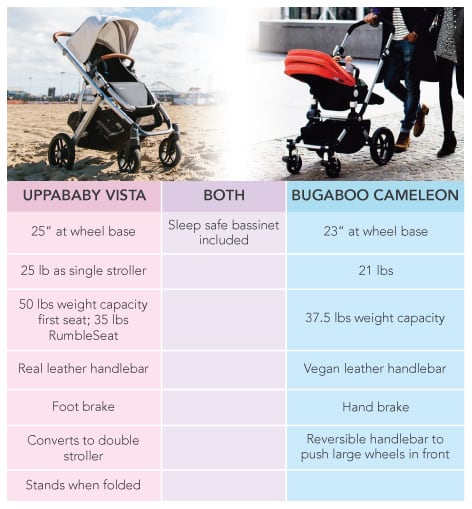 Side-by-side of the 2026 Uppababy Vista V3 and Bugaboo Cameleon 5, two of the most popular models from each brand.
Real-World Performance Insights
Our 6 months of testing highlighted clear performance differences that spec sheets don’t always capture:
- Urban maneuverability: Bugaboo’s smaller turning radius (21 inches vs. Uppababy’s 24 inches on average) makes it far easier to navigate crowded grocery store aisles, narrow apartment building hallways, and busy sidewalk crowds. The swiveling front wheels lock into place for smooth pushing on long walks, a feature Uppababy only added to its 2026 Vista and Cruz models.
- Terrain performance: Uppababy’s all-terrain Ridge model outperformed all Bugaboo models on gravel, dirt trails, and uneven park paths, with less vibration transferred to the handlebar. For families who regularly hike or visit rural areas, the Ridge is a clear pick, while Bugaboo’s Fox 5 is sufficient for occasional uneven pavement.
- One-handed use: Both brands offer one-hand recline and adjustable handlebars, but Bugaboo’s fold requires two hands to lock into place, while Uppababy’s 2026 fold can be completed and locked with one hand, a game-changer for parents holding a toddler or grocery bags. Uppababy’s signature simple one-hand fold is even more intuitive in 2026 models, with a mechanism that even new parents master in under a minute.
Common parent praises for both brands include durable construction, smooth rides, and stylish designs that hold up to daily use. The most frequent complaints we observed were Bugaboo’s higher accessory costs and slightly heavier weight on older non-Bee models, and Uppababy’s rear-access basket being less convenient for quick grabs while out. Both brands’ brake systems meet or exceed requirements set by the U.S. Consumer Product Safety Commission, with easy-to-use foot brakes that engage reliably even when the stroller is fully loaded with a toddler and a full diaper bag.
 The Uppababy Vista V3 and Bugaboo Fox 5 being tested on a gravel park trail for terrain performance.
 Uppababy’s signature one-hand fold in action, a key feature for parents managing multiple tasks while on the go.
Price, Warranty & Long-Term Value
As of 2026, base model strollers from both brands start at $799 for entry-level options and top out at $1,199 for premium all-terrain models. The biggest price difference comes from accessories: Bugaboo’s branded accessories (rain covers, car seat adapters, storage organizers) cost 20-30% more than comparable Uppababy add-ons, with individual accessories ranging from $49 to $129. You can also read our guide on what are disposable diapers properties.
Both brands offer a standard 2-year limited warranty covering manufacturing defects, with optional extended warranty plans. Bugaboo’s extended plan costs $149 for an extra 3 years of coverage, while Uppababy’s 2-year extension is $129. In terms of resale value, both brands hold 60-70% of their original value after 2 years of gentle use on resale platforms like Facebook Marketplace and Poshmark, with limited edition colorways retaining slightly higher value than standard options. For shoppers waiting for seasonal sales, we track the best stroller sales events each year to help you save 10-15% on premium models during holiday and end-of-season promotions.
Which Stroller Fits Your Lifestyle?
Your ideal pick depends almost entirely on your daily routine and long-term needs:
- City dwellers & frequent public transit users: Bugaboo’s smaller turning radius, front-access basket, and self-standing fold make it ideal for navigating crowded sidewalks, tight store aisles, and subway cars. Its 2026 updated wheels also glide more smoothly over cracked sidewalks and cobblestones common in older cities. For families prioritizing compact designs for crowded venues like theme parks, we break down the top picks in our urban stroller guide.
- Adventure families & off-road users: Uppababy’s Ridge all-terrain model is the clear winner for families who regularly hike, visit rural areas, or navigate unpaved paths. Its larger, shock-absorbing wheels reduce vibration for a smoother ride for both kids and parents pushing the stroller for hours.
- Frequent travelers: Uppababy’s one-hand fold and compatibility with most airline overhead bins (on the Minu V2 and Cruz V3 models) make it easier to navigate airports and plane cabins. Bugaboo’s Bee 6 is also overhead-bin compatible, but requires two hands to fold and lock.
- Growing families: Both brands offer convertible strollers that convert from a single to a double stroller with a second seat or standing board, but Uppababy’s conversion system is slightly easier to use, with no extra tools required to add a second seat. For families planning to have multiple kids close in age, this is a meaningful convenience.
- Budget-conscious premium buyers: Uppababy’s lower accessory costs and slightly lower base model prices make it a better value for shoppers who want premium features without the premium price tag. If you’re prioritizing raw build quality and design, Bugaboo’s magnesium alloy frame is slightly more durable for heavy daily use, but the difference is minimal for most families.
Frequently Asked Questions
What are the main differences between Bugaboo and Uppababy strollers in 2026?
The core difference comes down to design priority: Bugaboo focuses on sleek, modern design and urban maneuverability, with front-access storage and a smaller turning radius, while Uppababy prioritizes practical features for active families, including larger storage capacity, all-terrain options, and a more intuitive one-hand fold. Both brands meet or exceed all 2026 U.S. stroller safety standards, so the choice comes down to your specific lifestyle needs. You can also read our guide on best non diaper bag diaper bag.
Which brand is better for city living?
Bugaboo is generally better for dense urban environments, thanks to its smaller turning radius, front-access under-seat basket, and compact self-standing fold that takes up less space in small apartments and car trunks. Its 2026 updated wheels also glide more smoothly over cracked sidewalks and cobblestones common in older cities.
Are Bugaboo or Uppababy strollers safer for newborns?
Both brands offer newborn-compatible bassinet inserts and car seat adapters for all major infant car seat brands, and both meet or exceed safety standards set by the American Academy of Pediatrics for stroller use with infants. The only difference is that Bugaboo’s bassinet insert is included for free with most 2026 models, while Uppababy charges an extra $99 for the insert on most non-premium models. You can also read our guide on best strollers with cup holders.
Which brand has better resale value?
Both brands hold comparable resale value, with used 2026 models selling for 60-70% of their original price after 2 years of gentle use. Limited edition colorways and all-terrain models from both brands retain slightly higher value than standard options.
Can I use either brand’s stroller as a travel system?
Yes, both brands offer car seat adapters compatible with all major infant car seat brands (Graco, Chicco, Cybex, etc.) for use as a travel system. Uppababy also sells its own brand of infant car seats designed to snap directly into its strollers without adapters for added convenience. You can also read our guide on doona travel bag and accessories bundle.
Final Verdict & Next Steps
There’s no universal “best” stroller between Bugaboo and Uppababy — the right pick depends entirely on your daily routine, budget, and long-term needs. If you prioritize urban maneuverability, sleek design, and convenient front-access storage, Bugaboo’s 2026 lineup is the better fit. If you need all-terrain performance, a larger storage capacity, or a more intuitive one-hand fold for travel and active use, Uppababy’s 2026 models are the smarter choice.
Before you buy, test both strollers in person if possible: push them around your local grocery store, test the fold mechanism, and check how easy it is to access the storage basket with one hand while holding your child. For extra peace of mind, review our stroller safety requirements to confirm your chosen model meets all current safety requirements for your family’s needs. If you’re still on the fence, check out our guide to the best strollers for theme parks for a breakdown of top picks for high-use urban environments.

Sophia Linda is a freelance writer and Certified Health Coach based in the Newbury Park, CA. Passionate about healthy living, she focuses on helping families stay active and connected to the outdoors. Together with her husband and their three young children, Sophia spends much of her time traveling, hiking, and camping. Her work has been featured on the bestbabycart blog, and she brings a practical, real-world perspective to reviewing baby products for parents.