
A pull up diapers checklist is the tight, repeatable routine that gets a toddler or adult in and out of training pants without leaks, rash, or wasted minutes. Skip it, and you'll get rolled leg cuffs, soaked sheets, and a red rash by morning. Keep it, and the whole thing drops to about 60 seconds.
As of 2026, the American Academy of Pediatrics still pegs potty-training readiness between 18 months and 3 years, and most kids hit the pull-up phase around 18 to 24 months. Your checklist needs to flex with that age, the time of day, and the state of the skin. That's exactly what we're building here.
Quick Answer
A pull up diapers checklist has five phases: prep, apply, monitor, change, dispose. Gather wipes, a fresh pull-up, and barrier cream first. Size it, apply with smooth cuffs, check every 2 to 3 hours.
Soiled pull-ups go in a sealed trash bag, never the toilet.
The 60-Second Pull-Up Checklist (Before You Even Start)
Image source: Web (Bing) / newecocare.com (Web image (fair-use with source credit))
Before you reach for that pack of pull-ups, your workstation should already be set. This prep layer is the one most parents and caregivers skip, and it's the single biggest cause of rushed, messy applications.
Here's what belongs within arm's reach before you begin:
- A fresh pull-up in the correct size (confirm against the child's current weight, not last month's)
- Warm water and a soft washcloth, or fragrance-free wipes
- A small tube of barrier cream (zinc-oxide or plain petrolatum)
- A disposal bag or lined bin
- Clean hands: a 20-second wash or, if you're mid-play on the floor, hand sanitizer
If you juggle a toddler and a stroller, tuck a pre-sealed mini-kit into your everyday diaper bag. One wipe packet, one pull-up, a travel-size cream tube, a zip bag for soiled items. It lives there until the 3 p.m. mess hits.
Now the 60-second mental check. Ask yourself four things before you open the package:
- Size still right? Kids gain an inch of hip width fast. A pull-up that sat snug in March may gap at the thigh by June.
- More than 2 hours since the last change? If yes, you're in the "change and treat" branch, not the "top-and-go" branch.
- Skin showing redness, warmth, or a sour smell? That shifts you into the rash-treatment path before you put anything new on.
- Nighttime? Grab the high-absorbency overnight version and confirm the mattress protector is in place.
Sort those four answers and the actual application drops to under a minute. No fumbling, no "where did I put the wipes" panic. Just a clean, calm step.
What Changes Your Routine: Age, Context, and Skin Condition
A single checklist doesn't fit every situation. The variables that matter most are the wearer's age, the time and place, and the state of the skin.
Toddlers in potty-training (18 months to 3 years)
- Daytime: change every 2 to 3 hours or right after an accident. The pull-up doubles as a "your pants are wet" signal that builds the body awareness you need later.
- Nighttime: switch to the overnight absorbency version (12 to 16 oz capacity vs. 6 to 8 oz daytime). A frequent nighttime wake often means the child's bladder is maturing faster than the diaper can handle.
- Potty-training regression: if a 2-year-old starts "holding out" or refusing the pants, that's normal. Don't force the routine. Let the pull-up sit for a day, then ease back in.
Adults and seniors
- Check cadence tightens: every 2 to 3 hours during the day, one mid-sleep check overnight.
- Mobility matters. If the wearer can still walk, a pull-up preserves dignity and independence. Bed-bound? A tab brief or incontinence pad is safer and easier to manage.
- Skin is thinner and heals slower. Any redness you spot at a check gets a barrier-cream treatment before the next application.
Skin condition changes the whole flow
If skin is already raw, cracked, or showing a yeast rash (bright red border, small satellite bumps), you pause the "apply and go" step. You clean, air-dry for 30 to 60 seconds, apply a thin antifungal or barrier layer, and only then put the fresh pull-up on. More on that in the mistakes section below.
The rule is simple: same core steps, different cadence and product choice based on who's wearing it, where they are, and what the skin is telling you.
Step-by-Step: Prep, Apply, Monitor, Change, Dispose
This is the actual routine. Run it top to bottom and the whole thing takes about 60 to 90 seconds.
1. Remove and clean
- Undo the old pull-up from the bottom and cradle the legs upward.
- Wipe front to back (toddler) or cover all skin folds (adult).
- Pat dry. Don't rub.
- Inspect: any red patches, bumps, or warmth? Note it for the next step.
2. Prep the skin
- If skin is clean, skip ahead.
- If skin is pink or irritated, air-dry for 30 to 60 seconds, then apply a thin layer of barrier cream.
- For a confirmed yeast rash, an antifungal ointment beats plain petrolatum.
3. Apply the fresh pull-up
Image source: Web (Bing) / globalsources.com (Web image (fair-use with source credit))
- Open the waistband and smooth it flat.
- Step the wearer in, or slide it over the bottom for a non-mobility wearer.
- Pull up to the natural waistline. Not high enough to dig into the ribs, not low enough to gap.
- Smooth each elastic leg cuff outward, away from the body. A rolled or "balloon" cuff is the number one leak cause.
- Quick check: slide a finger under each cuff. No gap, no bunching, child can crawl or walk without it slipping.
4. Monitor
- Daytime: check or change every 2 to 3 hours.
- The wetness-indicator strip flips color on the first soak. It does not tell you when the core is full. Don't rely on it alone.
- Overnight: one check around 2 or 3 a.m. for adults. Toddlers: morning only, unless they wake you.
5. Dispose
- Wrap the soiled pull-up front-side-in and seal in a zip bag.
- Trash, not toilet. The superabsorbent polymer core will clog pipes and violate local waste codes.
- Wash hands for a full 20 seconds.
- Restock: keep a 7-to-14-day buffer and rotate by the manufacture date on the pack. An unopened pull-up holds quality for 3 to 5 years, but an open pack should be used within 30 days.
Sizing and Product Picks That Actually Work
Sizing is where most checklists fall apart. A toddler outgrowing a size or an adult whose weight has shifted means the pull-up no longer seals at the leg.
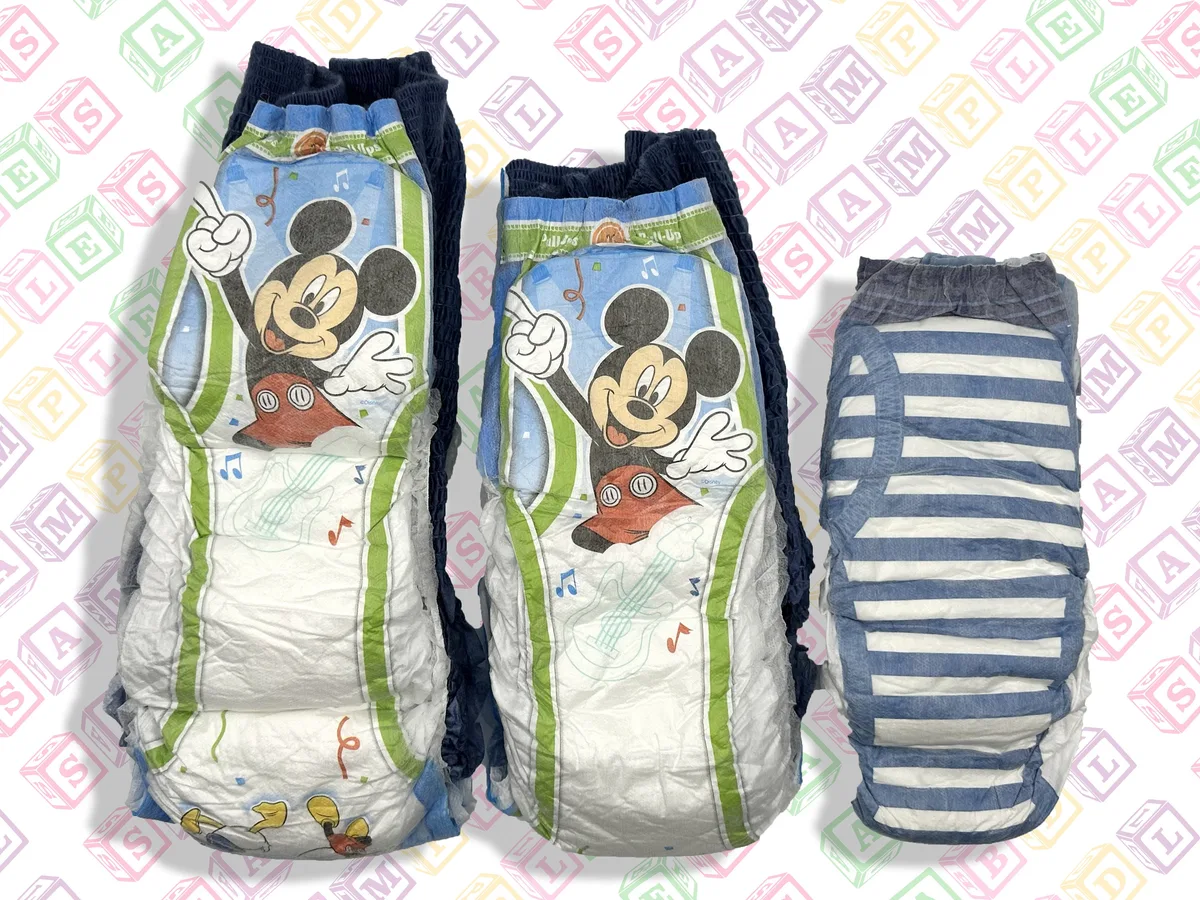
Image source: Web (Bing) / etsy.com (Web image (fair-use with source credit))
How to pick the right size
- Measure the wearer's waist and hip with a soft tape. Snug, not tight.
- Match to the brand's specific chart. Toddler "size 3" and adult "size M" do not map 1:1 across brands. Huggies, Pampers, Depend, and Tena all size differently.
- When in doubt between two sizes, go up. A slightly larger pull-up still stretches to seal. A too-small one gaps and leaks.
- Re-check monthly for toddlers, quarterly for adults.
What to look for on the package
- Absorbency rating: 6 to 8 oz for daytime, 12 to 16 oz for overnight. Confirm the number, not just the word "night."
- Tethered or stretch-to-seal leg cuffs. They hug the thigh better than a simple elastic band.
- Fragrance-free and dye-free lines for sensitive or reactive skin.
Pull-up vs. tab brief: when each wins
| Factor | Pull-up / training pants | Tab brief |
|---|---|---|
| Wearer can self-apply | Yes | No |
| Best for | Toddlers in training, active adults | Newborns, bed-bound seniors |
| Application time | 20 to 40 sec | 60 to 90 sec |
| Skin peeking | Limited | Easier to check front panel |
| Dignity factor | Looks like underwear | Obvious "diaper" look |
The checklist steps stay the same either way. You just swap the "step in" motion for a "wrap and tape" motion. Everything else, the monitoring cadence, the skin check, the disposal, runs identical.
Five Mistakes Turning a Simple Routine Into Leaks and Rashes
You don't need to memorize a 40-point list. Five errors account for the vast majority of leaks, rashes, and "why did the pull-up just…" moments.
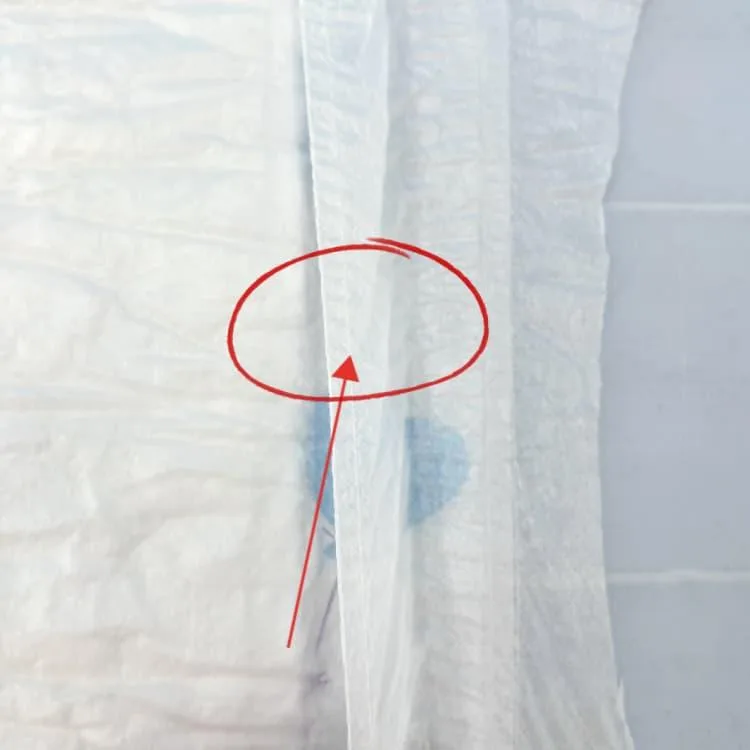
Image source: Web (Bing) / diaperrawmaterial.com (Web image (fair-use with source credit))
The rolled or balloon leg cuff. You smoothed the cuff outward at application. Then the wearer crawled, walked, or shifted, and the cuff rolled up toward the inner thigh. Now there's a gap between skin and elastic.
Urine pools at that gap and soaks through. Fix: re-smooth the cuff outward every single change. Make it the last physical step before you walk away.
Sticking with the same size for months. A 13-month-old in a "size 2" will have a size-3 hip circumference by about six weeks. The elastic still stretches, but the leg gap widens. Leaks follow.
Re-measure monthly during potty-training, quarterly for adults.
Trusting the wetness indicator as your only cue. The color strip flips on the first 1 to 2 ounces of moisture. The absorbent core behind it can hold 6 to 16 more ounces. By the time the core saturates, the strip has been "wet" for hours.
You still need the 2-to-3-hour check cadence, especially overnight.
Skipping the skin air-dry step. You already know the 30-to-60-second air-dry from the application step. Skip it and you're trapping heat under a fresh, dry pull-up. That's how mild redness becomes a candidal rash within 24 hours.
If you spot a bright-red border with tiny satellite bumps, that's yeast. A topical antifungal cream handles it. Plain zinc-oxide won't.
Flushing the pull-up. The superabsorbent polymer core expands to roughly 20 times its dry weight in water. That ball of gel will jam a residential drain or a septic tank within weeks. The CDC's household-waste guidance is clear: solid incontinence products belong in a sealed trash bag, not the toilet.
No exceptions.
Safety, Disposal Rules, and When to Worry
Per FDA classification, adult incontinence products like Depend, Tena, and Attends are regulated as Class II medical devices. They must pass specific absorbency and biocompatibility tests before hitting retail. Toddler pull-ups don't carry that designation.
They're consumer products governed by general safety standards.
For immobile adults, a pull-up alone is not enough. If someone is bed-bound or has very limited mobility, the 2-to-3-hour check window protects against pressure sores. Skin left damp and unturned for four or more hours breaks down fast.
Pair the pull-up checklist with a turning schedule, not just a product swap.
Call a doctor if you spot any of these:
- A rash with a bright-red border and small satellite bumps (yeast, not simple irritation)
- Skin that feels hot, swollen, or drains pus at a red patch
- A new urinary tract infection pattern: cloudy urine, burning, low-grade fever
- Pressure marks that don't fade within 30 seconds of removing the pull-up
In institutional settings (assisted living, nursing homes), state licensing boards and the UK's CQC require a documented skin check at every change. That means a log entry: time, skin condition, action taken. Skip that and you're not just missing a step, you're missing a regulatory one.
FAQ: The Questions That Come Up Mid-Routine
How often should I change pull-up diapers during the day?
Every 2 to 3 hours is the baseline for both toddlers and adults. Shorten that in hot or humid climates where the core saturates faster. If the wetness indicator has flipped color, treat it as a check cue, not an all-clear.
You still need the timed check.
Can a 4-year-old still need pull-ups at night?
Yes. Nighttime bladder control matures later than daytime control. Per AAP guidance, some kids aren't fully dry at night until age 5 or 6.
If your 4-year-old is dry by 3 p.m. but wets the bed by morning, overnight pull-ups are a normal part of the process, not a failure.
Do pull-up diapers expire?
Unopened packs hold quality for 3 to 5 years from the manufacture date. The superabsorbent polymer core doesn't go bad, but the outer film can dry out and the elastic cuffs lose stretch. Once you crack open a pack, use the contents within 30 days to keep the seal and absorbency intact.
What's the real difference between a pull-up and a tab diaper?
A pull-up has no fasteners. You step in, pull up, and smooth the cuffs. A tab diaper wraps around and secures with adhesive strips.
Pull-ups preserve dignity and let the wearer self-apply. Tabs give more adjustability for a fidgety newborn or a bed-bound senior. The checklist steps stay identical.
Only the application motion changes.
Should I use pull-ups or regular diapers for potty training?
Switch to pull-ups around 18 to 24 months, once your child can pull garments to hip level. The step-in design builds the exact muscle memory they'll need for underwear later. Staying in tab diapers past that window removes that practice.
Going back to tabs after the switch is harder than moving forward.

Taslima Khanam Sultana, a loving mom of three, founded BestBabyCart.com to help new parents navigate the world of baby products with ease. Her passion for making parenting simpler shines through delivering honest, unbiased reviews on must-haves like diapers, strollers, and feeding gear. Taslima’s mission is to empower families with expert tips, ensuring every product is safe and top-quality for your little one. Drawing from her own parenting journey, she’s dedicated to supporting yours!