

Waiting to see what color your baby’s eyes will be is one of the most delightful, low-stakes mysteries of early parenthood. While no tool can give a 100% guaranteed answer, a baby eye color calculator uses established genetic principles to give you a fun, probabilistic estimate of your little one’s likely eye shade, based on your and your partner’s family history. At BestBabyCart, we’ve compiled evidence-based insights to help you understand the science behind these predictions, what to expect as your baby’s eyes develop, and answers to all your most pressing questions about this small but magical part of your baby’s identity.
The Science of Baby Eye Color
Eye color is not a random trait — it is a polygenic characteristic shaped by multiple genes, melanin production, and even the physical structure of the iris. Understanding these basics will help you make sense of calculator results and the changes you’ll see in your baby’s eyes over their first few years. You can also read our guide on BestBabyCart.com.
Polygenetic Inheritance and Iris Pigmentation
For decades, scientists believed eye color was controlled by a single dominant gene (with brown dominant over blue), but modern research has identified at least 16 genes that influence final eye color, with OCA2 and HERC2 playing the largest roles. These genes regulate melanin production: the pigment that gives eyes their hue. Two types of melanin drive color variation:
- Eumelanin: Produces dark brown and black pigment; higher concentrations result in darker eyes
- Pheomelanin: Produces red and yellow pigment; higher concentrations create green, hazel, or amber shades
Iris structure also impacts perceived color. The stroma, the front layer of the iris, contains collagen fibers that scatter light. Blue eyes appear blue not because of blue pigment, but because light scatters off the low-melanin stroma in a way that reflects blue wavelengths, similar to how the sky appears blue. Brown eyes have enough melanin to absorb most scattered light, resulting in a dark appearance.
Why Newborns Are Born With Light Eyes
Nearly all babies are born with blue, gray, or slate-colored eyes because melanin production in the iris is extremely low at birth. Melanin production ramps up in the first 6–12 months of life, driven by light exposure and natural development, leading to gradual color shifts. Babies with darker skin tones often have more melanin present at birth, so their eyes may only darken slightly over time, while lighter-skinned babies often see dramatic shifts from pale blue to brown, green, or hazel over their first 3 years. You can also read our guide on the best stroller footmuff keeping baby warm in the winter.
 Newborns are often born with pale blue or gray eyes that may shift to their permanent shade over the first 3 years
How Baby Eye Color Calculators Work
Baby eye color calculators use simplified models of genetic inheritance to estimate the probability of different eye colors for your baby, based on inputs you provide. While they are not medically precise, they are a fun way to explore possible outcomes and learn about genetic inheritance.
Key Inputs for Accurate Predictions
Basic calculators only ask for your and your partner’s eye colors, but more advanced tools let you add additional context to improve estimate accuracy:
- Grandparents’ eye colors: Recessive genes can skip generations, so including grandparent eye colors helps identify hidden recessive traits
- Family history of rare eye colors: If your family has a history of green, gray, or amber eyes, this increases the chance your baby inherits those traits
- Ancestral background: Certain eye colors are far more common in specific populations (e.g., blue eyes are most common in Northern and Eastern Europe, brown eyes dominate in Africa, Asia, and Southern Europe)
Calculators use Mendelian inheritance probabilities as a baseline, then adjust for the polygenic nature of eye color to give a range of possible outcomes, rather than a single definitive answer. For more on this, see our guide on comfy stuff in baby crib.
Limitations of Predictive Tools
It is important to approach baby eye color calculator results as a fun estimate, not a guarantee. No tool can account for rare spontaneous genetic mutations, underlying conditions that affect pigmentation (like Waardenburg syndrome or albinism), or the small chance of heterochromia (two different colored eyes). For medical questions about your baby’s eye health or development, always consult a pediatric ophthalmologist.
Common Eye Color Outcomes by Parent Genetics
While surprises are always possible, parental eye color is the strongest predictor of your baby’s likely eye shade. The table below outlines common outcomes based on standard genetic probabilities, adjusted for the polygenic nature of the trait:
| Parent 1 Eye Color | Parent 2 Eye Color | Most Likely Baby Eye Color | Possible Alternative Colors |
|---|---|---|---|
| Brown | Brown | Brown | Green, blue (if both parents carry recessive blue/green genes) |
| Brown | Blue | Brown | Green, blue |
| Brown | Green/Hazel | Brown | Green, hazel |
| Blue | Blue | Blue | Green (rare, if carrying green gene) |
| Green/Hazel | Green/Hazel | Green/Hazel | Blue, brown (rare) |
| Gray/Amber | Any | Matches dominant parent | Varies based on family history |
Brown eyes are the most common global eye color, as the brown melanin allele is dominant, but recessive genes for lighter colors can be passed down even if no recent ancestors have those traits. A common observation among pediatric ophthalmologists is that two brown-eyed parents with European ancestry are far more likely to have a blue-eyed baby if recessive blue-eye genes are present in the family line, even if no close relatives have blue eyes. For more on this, see our guide on void baby space fungus.
 Brown eyes are the most common globally, followed by blue, green, and rarer shades like gray and amber
Typical Eye Color Development Timeline
Most parents notice the first shifts in their baby’s eye color between 3 and 6 months, but the full process can take up to 3 years. Knowing this timeline will help you avoid unnecessary worry about slow changes.
0–6 Months: Initial Shifts
Melanin production ramps up rapidly during this period, so you may notice your baby’s pale blue or gray eyes darken slightly, or develop flecks of green, hazel, or brown. Changes are often subtle at first, and may only be noticeable when comparing recent photos to newborn shots. For more on this, see our guide on how many coats does a baby need for.
6 Months–3 Years: Stabilization to Permanent Color
The most dramatic eye color changes happen between 6 months and 2 years, as melanin levels reach their final set point. By age 3, 90% of children have their permanent eye color, though very subtle shifts (like hazel eyes becoming more golden) can occur up to age 5 in rare cases. If your baby’s eye color changes suddenly after age 3, mention it to their pediatrician to rule out underlying conditions.
Rare and Unique Baby Eye Colors
While brown, blue, and green are the most common eye colors, some babies are born with rare, striking shades that make their eyes truly one-of-a-kind.
Gray, Green, and Amber Eyes
- Gray eyes: Occur in roughly 1% of the global population, caused by an unusual collagen structure in the stroma that scatters light differently than blue eyes, giving a soft gray appearance that can look blue in certain lighting
- Green eyes: Found in approximately 2% of people, caused by moderate melanin levels plus light scattering, often with golden or brown flecks
- Amber eyes: Extremely rare (<1% of the population), caused by a higher concentration of pheomelanin than brown eyes, giving a bright golden or copper hue
Heterochromia and Albinism
Heterochromia is a condition where a person has two different colored eyes, or a patch of a different color in one eye. It is usually harmless and genetic, but in rare cases can be linked to underlying conditions, so it is always worth mentioning to your pediatrician. Albinism, a genetic condition that causes a total lack of melanin, results in very pale blue, gray, or even reddish-violet eyes, and is almost always accompanied by light sensitivity and very fair skin and hair.
Common Myths About Baby Eye Color
Misinformation about eye color is widespread, so let’s debunk the most common myths to help you set realistic expectations:
- Myth: Eye color is determined by a single gene. Fact: Eye color is polygenic, influenced by at least 16 different genes, which is why predictions are never exact and surprises are common.
- Myth: Two brown-eyed parents can’t have a blue-eyed baby. Fact: If both parents carry the recessive blue-eye allele, there is a 25% chance per pregnancy of a blue-eyed child, even if no recent ancestors have blue eyes.
- Myth: Eye color changes are always dramatic. Fact: Many babies have subtle shifts, like blue eyes turning to light brown, that are easy to miss if you are not watching closely over time.
- Myth: You can predict the exact shade of your baby’s eyes. Fact: Calculators only give probability ranges for broad color categories (brown, blue, green), not exact shades, because small genetic variations create huge differences in final hue (e.g., light brown vs. dark brown, forest green vs. olive green).
When to Consult a Pediatrician About Eye Color Changes
While gradual eye color changes are completely normal in the first 3 years of life, certain signs warrant a checkup with your pediatrician or a pediatric ophthalmologist:
- Sudden, unexplained eye color changes after age 3
- One eye that is a significantly different color than the other with no family history of heterochromia
- Redness, cloudiness, or uneven pupil size accompanying color changes
- Light sensitivity that seems unusual for your baby’s eye color
For official guidance on children’s eye health milestones and warning signs, refer to the CDC’s children’s eye health facts page.
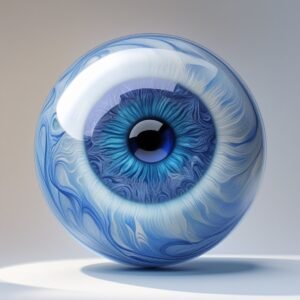
 Higher melanin levels in the iris produce darker brown eyes, while lower levels create lighter blue or green shades
Frequently Asked Questions
Can a baby eye color calculator be 100% accurate?
No. Baby eye color calculators use probabilistic genetic models, but because eye color is influenced by at least 16 different genes, plus rare mutations, no tool can guarantee an exact outcome. They are designed for fun, not medical diagnosis.
When will my baby’s eye color be permanent?
Most babies have their final eye color by 12–18 months, though subtle shifts can continue up to age 3. Babies with darker skin tones often reach their permanent color earlier than lighter-skinned babies.
Can two brown-eyed parents have a blue-eyed baby?
Yes, if both parents carry the recessive allele for blue eyes. Even if neither parent has blue eyes, they can pass the recessive gene to their child, resulting in a blue-eyed baby in roughly 25% of pregnancies where both parents are carriers.
Do grandparents’ eye colors affect my baby’s eye color?
Yes. Recessive genes can skip generations, so if a grandparent has blue, green, or another rare eye color, that increases the chance your baby inherits that trait, even if you and your partner both have brown eyes. Including grandparent eye colors in a calculator improves prediction accuracy.
Are green eyes common in babies?
No. Green eyes occur in roughly 2% of the global population, making them a relatively rare outcome. They are most likely if one or both parents have green or hazel eyes, or if there is a family history of green eyes.
Can nutrition or environment affect my baby’s eye color?
No. Eye color is determined entirely by genetics and melanin production in the iris. Diet, sun exposure, or other environmental factors do not change eye color after birth.
What is heterochromia, and is it dangerous?
Heterochromia is a condition where a person has two different colored eyes, or a section of a different color in one eye. It is usually harmless and genetic, but in rare cases can be linked to underlying conditions like Waardenburg syndrome, so it is always worth mentioning to your pediatrician if you notice it.
Conclusion
Guessing your baby’s eye color is a heartwarming way to bond with your little one before they arrive, and watching their eyes shift to their permanent shade over their first few years is a truly special parenting milestone. While baby eye color calculators are a fun way to explore possible outcomes, the most exciting part is celebrating whatever unique shade your baby ends up with — every eye color is beautiful, and every shift is a reminder of how fast they are growing. For a free, easy-to-use tool to explore possible eye color outcomes for your little one, try our Baby Eye Color Calculator today — just input your and your partner’s eye colors and family history for a personalized probabilistic estimate.
Between tracking your baby’s eye color shifts and stocking up on newborn essentials, early parenthood is full of small, joyful milestones. As your baby’s eye color shifts over their first year, you’ll also be adjusting their seasonal wardrobe, so planning for winter coats is a helpful early parenting task. Creating a calm, low-stimulation nursery space with soft, safe crib bedding supports your baby’s visual development as their eye color matures. Pair regular pediatric checkups with gentle, affordable baby hairbrushes to care for your newborn’s delicate features as they grow. Just like the fun of playful baby surprise activities, discovering your baby’s final eye color is a delightful, one-of-a-kind moment. If you’re looking for low-key ways to connect with other parents while sharing your eye color predictions, finding flexible outing ideas for early bedtimes can help you build your support network.

Taslima Khanam Sultana, a loving mom of three, founded BestBabyCart.com to help new parents navigate the world of baby products with ease. Her passion for making parenting simpler shines through delivering honest, unbiased reviews on must-haves like diapers, strollers, and feeding gear. Taslima’s mission is to empower families with expert tips, ensuring every product is safe and top-quality for your little one. Drawing from her own parenting journey, she’s dedicated to supporting yours!