Jogging strollers are purpose-built for active parents, with features that standard umbrella or travel strollers lack: a lockable front wheel for stability at speed, all-terrain suspension to absorb bumps, and reinforced frames to withstand regular use on trails, sidewalks, and park paths. Unlike regular strollers, most joggers are designed to accommodate both newborns (via infant car seat compatibility or near-flat recline) and toddlers up to 50–75 lbs, making them a long-term investment for families who want to stay active through every stage of early childhood.
If you’re a casual walker, a weekend trail runner, or a daily jogger, the right model will keep your child safe and comfortable while letting you move freely. We’ve tested dozens of jogging strollers over pavement, packed dirt, and crowded park paths to curate this list of the best options for infants and toddlers in 2026, with honest trade-offs and real-world performance insights to help you choose. You can also read our guide on best stroller for jogging.
How To Choose The Right Jogging Stroller For Infants And Toddlers
Before diving into our top picks, prioritize these key features to find a model that matches your needs:
Core Safety Features
First and foremost, select a model that meets or exceeds current 2026 juvenile product safety standards. Non-negotiable features include:
- A 5-point harness that secures your child at the shoulders, hips, and crotch to prevent falls or ejection during sudden stops
- A lockable front wheel: fixed or lockable swivel front wheels eliminate wobble at jogging speeds (5+ mph) and reduce tipping risk on uneven terrain; a common mistake new parents make is choosing a swivel-only model, which can feel unstable when running
- An accessible hand brake that lets you control speed on downhill stretches without taking your hand off the handlebar
- Reflective trim or integrated lights for low-light visibility, a standard requirement for all 2026 compliant jogging strollers For evidence-based safety guidance, refer to the CDC’s official child stroller safety recommendations to confirm your chosen model meets core requirements.
Infant & Newborn Compatibility
If you plan to use the stroller for infants under 6 months old (before they have full head control), you’ll need either:
- A compatible infant car seat adapter: most joggers support universal adapters for major brands like Graco, Chicco, and Evenflo, while some brands (like Chicco) only work with their own car seat ecosystem
- A near-flat recline position (160 degrees or higher) that is approved by the manufacturer for newborn use without a car seat
- Optional bassinet attachments (sold separately for most models) for newborns who are too small for standard car seats Look for a stroller with a high weight limit (up to 50–75 lbs) that will accommodate your child as they hit toddler growth milestones, saving you from having to replace gear after just one year of use.
Ride Quality & Terrain Performance
Match the stroller’s tires and suspension to your typical jogging terrain:
- Pavement/city running: 12-inch air-filled or foam tires with basic suspension work well for smooth sidewalks and paved park paths
- Light trails/grass: 14–16-inch air-filled tires with adjustable suspension absorb bumps from packed dirt, tree roots, and uneven grass
- Technical off-road trails: Look for models with all-terrain pneumatic tires, heavy-duty suspension, and a weight capacity of 75+ lbs for durability Adjustable handlebars that accommodate parents of different heights reduce back strain during long runs, a feature often overlooked in budget models.
Practicality For Daily Use
Even if you only jog occasionally, choose a stroller that works for everyday errands:
- A one-hand folding mechanism lets you fold the stroller while holding your child or carrying groceries
- An under-seat storage basket that fits a diaper bag, extra layers, and snacks eliminates the need for a separate bag
- A lightweight frame (under 20 lbs) is easier to lift into car trunks and carry up stairs
- For cold-weather use, pair your stroller with proper seasonal baby layering guidance to keep your infant or toddler warm without overheating during stops
- After rainy or muddy runs, dry the stroller frame and seat thoroughly to avoid mold and mildew growth, which can degrade fabric and pose health risks for young children.
Top Jogging Stroller Picks For Infants And Toddlers
We’ve ranked our picks by performance, value, and suitability for dual infant/toddler use:
1. BOB Revolution Flex 3.0 – Best Overall For Serious Runners
 The gold standard for jogging strollers, built for high-speed running and rough terrain
The BOB Revolution Flex 3.0 is the top pick for serious runners who log 3+ jogs per week on mixed terrain. In practice, its fixed front wheel stays stable even at sprint speeds, and its adjustable 3-point suspension absorbs bumps from packed dirt, cobblestones, and cracked pavement without jostling a sleeping infant. The seat accommodates children up to 75 lbs, so you can use it from infancy (with a compatible car seat adapter, sold separately) through the toddler years, and the adjustable handlebar fits parents from 5’ to 6’4” without back strain.
The hand brake provides reliable control on downhill stretches, and the large storage basket fits a diaper bag, water bottles, and post-run snacks. It’s compatible with a wide range of BOB and third-party accessories, from parent trays to weather shields.
Pros:
The gold standard for jogging strollers, built for high-speed running and rough terrain
The BOB Revolution Flex 3.0 is the top pick for serious runners who log 3+ jogs per week on mixed terrain. In practice, its fixed front wheel stays stable even at sprint speeds, and its adjustable 3-point suspension absorbs bumps from packed dirt, cobblestones, and cracked pavement without jostling a sleeping infant. The seat accommodates children up to 75 lbs, so you can use it from infancy (with a compatible car seat adapter, sold separately) through the toddler years, and the adjustable handlebar fits parents from 5’ to 6’4” without back strain.
The hand brake provides reliable control on downhill stretches, and the large storage basket fits a diaper bag, water bottles, and post-run snacks. It’s compatible with a wide range of BOB and third-party accessories, from parent trays to weather shields.
Pros:
- Unmatched stability at high jogging speeds
- Adjustable suspension for all terrain types
- 75 lb weight limit for long-term use
- Adjustable handlebar for parent comfort
- Wide accessory ecosystem Cons:
- Premium price point ($500+)
- Bulkier fold (28 inches wide) may not fit in small car trunks
- 27 lb frame is heavier than budget models Best for: Serious runners, families who jog on mixed terrain, and parents who want a stroller that lasts through multiple children. Check current price on Amazon
2. Delta Children Apollo Jogging Stroller – Best Budget Pick For City Runners
 A reliable, affordable jogger for neighborhood runs and newborn travel
The Delta Apollo is the best budget-friendly option for parents who mostly jog on smooth pavement and need a stroller that works for infants from day one. Its shock-absorbing frame smooths out cracks and bumps on city sidewalks, and the large UPF 50+ canopy blocks sun and light rain for long outings. The near-flat recline is suitable for newborn naps, and the universal car seat adapter fits most major infant car seat brands, so you don’t need to buy a separate travel system.
It folds compactly (24 inches wide) to fit in most sedan trunks, and the 5-point harness keeps toddlers secure as they grow. The 12-inch air-filled tires provide a smooth ride, though they’re not suitable for rocky or technical trails.
Pros:
A reliable, affordable jogger for neighborhood runs and newborn travel
The Delta Apollo is the best budget-friendly option for parents who mostly jog on smooth pavement and need a stroller that works for infants from day one. Its shock-absorbing frame smooths out cracks and bumps on city sidewalks, and the large UPF 50+ canopy blocks sun and light rain for long outings. The near-flat recline is suitable for newborn naps, and the universal car seat adapter fits most major infant car seat brands, so you don’t need to buy a separate travel system.
It folds compactly (24 inches wide) to fit in most sedan trunks, and the 5-point harness keeps toddlers secure as they grow. The 12-inch air-filled tires provide a smooth ride, though they’re not suitable for rocky or technical trails.
Pros:
- Shock-absorbing frame for smooth pavement rides
- Universal infant car seat compatibility
- UPF 50+ large canopy with peek-a-boo window
- Compact fold fits most car trunks
- Near-flat recline for newborn naps Cons:
- 18 lb frame is heavier than umbrella strollers
- Basic suspension is not ideal for rough off-road terrain
- Limited accessory compatibility Best for: Budget-conscious city runners, new parents needing a stroller that works from infancy, and families with limited storage space. Check current price on Amazon
3. Chicco Activ3 Jogging Stroller – Best All-Terrain Option For Chicco Users
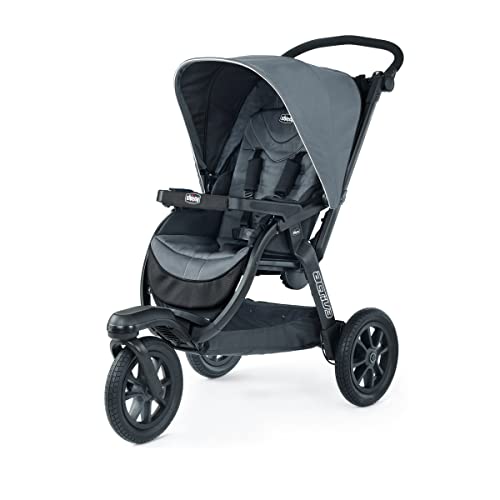 A premium all-terrain jogger with seamless Chicco car seat integration
The Chicco Activ3 is the top pick for parents who already use Chicco infant car seats and want a stroller that handles both city runs and light trail adventures. Its 16-inch pneumatic all-terrain tires and adjustable suspension absorb bumps from packed dirt, grass, and cracked pavement, and the lockable front wheel stays stable at jogging speeds. The near-flat recline is approved for newborn use, and the dedicated Chicco KeyFit car seat adapter lets you move your baby from car to stroller in seconds without adjusting the harness.
It folds compactly (25 inches wide) to fit in most car trunks, and the adjustable handlebar reduces back strain during long runs. The under-seat storage basket fits a diaper bag and small cooler for day trips.
Pros:
A premium all-terrain jogger with seamless Chicco car seat integration
The Chicco Activ3 is the top pick for parents who already use Chicco infant car seats and want a stroller that handles both city runs and light trail adventures. Its 16-inch pneumatic all-terrain tires and adjustable suspension absorb bumps from packed dirt, grass, and cracked pavement, and the lockable front wheel stays stable at jogging speeds. The near-flat recline is approved for newborn use, and the dedicated Chicco KeyFit car seat adapter lets you move your baby from car to stroller in seconds without adjusting the harness.
It folds compactly (25 inches wide) to fit in most car trunks, and the adjustable handlebar reduces back strain during long runs. The under-seat storage basket fits a diaper bag and small cooler for day trips.
Pros:
- All-terrain tires and suspension for varied surfaces
- Seamless compatibility with Chicco infant car seats
- Near-flat recline approved for newborn use
- Compact, travel-friendly fold
- Adjustable handlebar for parent comfort Cons:
- Car seat adapter is only compatible with Chicco KeyFit models
- Premium price point ($350+)
- 22 lb frame is heavier than budget joggers Best for: Chicco car seat owners, all-terrain runners, and families who travel frequently with their stroller. Check current price on Amazon
4. BABY JOY Foldable Jogging Stroller – Best Mid-Range Value Pick
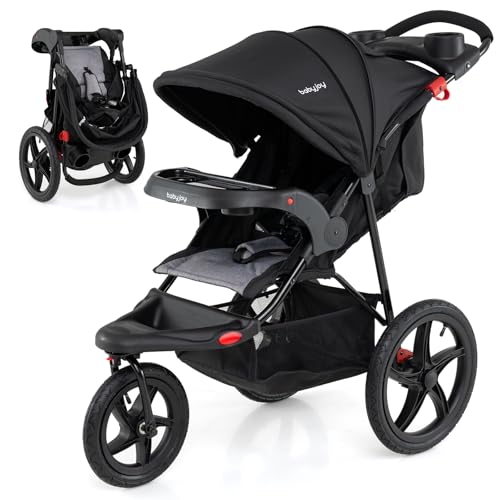 A feature-packed mid-range jogger with smooth ride quality for everyday use
The BABY JOY jogger delivers premium features at a mid-range price point, making it ideal for parents who jog occasionally and want a stroller that works for both infants and toddlers. Its 12-inch air-filled tires and front suspension absorb bumps from city sidewalks and park paths, and the adjustable canopy and near-flat recline keep infants comfortable for naps. The universal car seat adapter fits most major brands, so you can use it from day one.
It includes a removable child tray with a cup holder and a parent tray with a phone slot and two cup holders, making it easy to grab snacks and drinks on the go. The one-hand fold is simple, and the under-seat storage basket fits a diaper bag and extra layers.
Pros:
A feature-packed mid-range jogger with smooth ride quality for everyday use
The BABY JOY jogger delivers premium features at a mid-range price point, making it ideal for parents who jog occasionally and want a stroller that works for both infants and toddlers. Its 12-inch air-filled tires and front suspension absorb bumps from city sidewalks and park paths, and the adjustable canopy and near-flat recline keep infants comfortable for naps. The universal car seat adapter fits most major brands, so you can use it from day one.
It includes a removable child tray with a cup holder and a parent tray with a phone slot and two cup holders, making it easy to grab snacks and drinks on the go. The one-hand fold is simple, and the under-seat storage basket fits a diaper bag and extra layers.
Pros:
- Smooth air-filled tires and front suspension
- Universal infant car seat compatibility
- Parent and child trays with cup holders
- One-hand compact fold
- High weight limit (50 lbs) for toddler use Cons:
- Requires monthly tire pressure checks for optimal performance
- Basic suspension is not suitable for rough off-road trails
- Seat padding is less supportive for long naps than premium models Best for: Mid-range budget runners, families who want practical features without a premium price tag, and parents who jog 1–2 times per week. Check current price on Amazon Note: A gray color variant of this model is also available with identical features and performance.
5. Baby Trend Expedition Race Tec Plus Travel System – Best Travel System For New Parents
 An all-in-one solution for newborns and toddlers, no separate car seat purchase needed
The Baby Trend Race Tec Plus is the best pick for new parents who want a single purchase that works from infancy through toddlerhood. It includes the EZ-Lift Plus infant car seat (weight limit 30 lbs, compatible with Baby Trend and most Graco car seat bases) so you can move your baby from car to stroller without waking them. The jogger frame has a lockable front wheel for stable running, and the 12-inch foam-filled tires provide a smooth ride on pavement and light trails.
The seat reclines for toddler naps, and the adjustable handlebar fits parents of different heights. The under-seat storage basket holds a diaper bag and snacks, and the hand brake provides control on downhill runs.
Pros:
An all-in-one solution for newborns and toddlers, no separate car seat purchase needed
The Baby Trend Race Tec Plus is the best pick for new parents who want a single purchase that works from infancy through toddlerhood. It includes the EZ-Lift Plus infant car seat (weight limit 30 lbs, compatible with Baby Trend and most Graco car seat bases) so you can move your baby from car to stroller without waking them. The jogger frame has a lockable front wheel for stable running, and the 12-inch foam-filled tires provide a smooth ride on pavement and light trails.
The seat reclines for toddler naps, and the adjustable handlebar fits parents of different heights. The under-seat storage basket holds a diaper bag and snacks, and the hand brake provides control on downhill runs.
Pros:
- Includes infant car seat for newborn use from day one
- Lockable front wheel for stable jogging
- Foam-filled tires require no maintenance
- Reclining seat for toddler naps
- Excellent value for a combined travel system Cons:
- Car seat adds 10 lbs to the total stroller weight
- Basic suspension is not suitable for rough off-road terrain
- Car seat is only compatible with Baby Trend/Graco bases Best for: New parents, families on a budget who want an all-in-one solution, and casual runners who mostly use paved paths. Check current price on Amazon
6. Delta Children Jeep Classic Jogger – Best Durable Pick For Light Trails
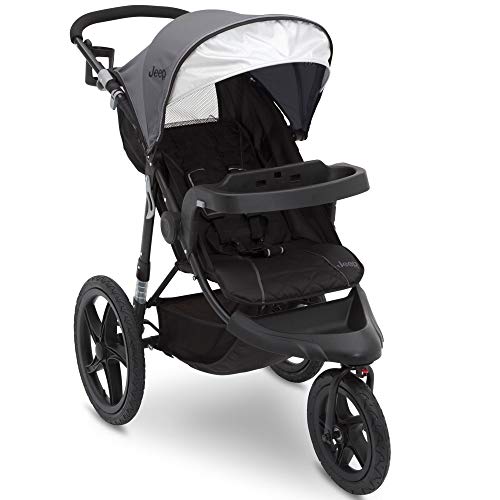 A rugged, stylish jogger built for frequent use on light trails and sidewalks
The Jeep Classic Jogger stands out for its durable steel frame and rugged, adventure-ready aesthetic, making it a favorite for families who jog on light trails and park paths regularly. Its 12-inch foam-filled tires never need air pressure checks, and the lockable swivel front wheel lets you switch between easy everyday maneuvering and stable jogging mode with a push of a button. The large canopy has a UPF 50+ rating and a peek-a-boo window to check on your child without stopping.
The seat fits toddlers up to 50 lbs, and the universal car seat adapter works with most infant car seats for newborn use. The under-seat storage basket holds 10 lbs of gear, and the one-hand fold is simple for travel.
Pros:
A rugged, stylish jogger built for frequent use on light trails and sidewalks
The Jeep Classic Jogger stands out for its durable steel frame and rugged, adventure-ready aesthetic, making it a favorite for families who jog on light trails and park paths regularly. Its 12-inch foam-filled tires never need air pressure checks, and the lockable swivel front wheel lets you switch between easy everyday maneuvering and stable jogging mode with a push of a button. The large canopy has a UPF 50+ rating and a peek-a-boo window to check on your child without stopping.
The seat fits toddlers up to 50 lbs, and the universal car seat adapter works with most infant car seats for newborn use. The under-seat storage basket holds 10 lbs of gear, and the one-hand fold is simple for travel.
Pros:
- Durable steel frame for heavy daily use
- Lockable swivel front wheel for versatile use
- Foam-filled tires require no maintenance
- UPF 50+ canopy with peek-a-boo window
- Universal infant car seat compatibility Cons:
- Foam tires are less shock-absorbent than air-filled tires on very rough pavement
- 18 lb frame is heavier than entry-level models
- Limited suspension for bumpy trails Best for: Families who jog on light trails, style-focused buyers, and parents who want a low-maintenance, durable stroller. Check current price on Amazon
7. Baby Trend Expedition Double Jogger – Best Double Stroller For Siblings
 A spacious double jogger for running with two children at once
For parents of two young children, the Baby Trend Expedition Double Jogger lets you jog with both kids simultaneously without needing a separate single stroller. Each seat has an independent recline, so one child can nap while the other sits upright, and each seat has its own 5-point harness and adjustable footrest for comfort. The large canopy covers both seats for sun protection, and the extra-large storage basket fits gear for two kids.
The lockable front wheel stays stable at jogging speeds, and the adjustable hand brake gives you control on downhill stretches. The handlebar is adjustable for parents of different heights.
Pros:
A spacious double jogger for running with two children at once
For parents of two young children, the Baby Trend Expedition Double Jogger lets you jog with both kids simultaneously without needing a separate single stroller. Each seat has an independent recline, so one child can nap while the other sits upright, and each seat has its own 5-point harness and adjustable footrest for comfort. The large canopy covers both seats for sun protection, and the extra-large storage basket fits gear for two kids.
The lockable front wheel stays stable at jogging speeds, and the adjustable hand brake gives you control on downhill stretches. The handlebar is adjustable for parents of different heights.
Pros:
- Two independent seats for siblings of different ages
- Independent recline for each seat
- Extra-large storage basket for two kids’ gear
- Lockable front wheel for stable jogging
- Adjustable hand brake for downhill control Cons:
- 36-inch width is too wide for standard store aisles and narrow sidewalks
- 38 lb frame is difficult to lift into car trunks alone
- Infant car seat adapters are sold separately
- Not suitable for technical off-road trails Best for: Families with two young children, active parents who want to jog with both kids, and parents who regularly take both children on outings. Check current price on Amazon
8. Baby Trend Journey Jogging Stroller – Best Entry-Level Pick For Casual Runners
 An affordable, no-frills jogger for occasional walks and light jogs
The Baby Trend Journey is the best entry-level option for parents who only jog occasionally (1–2 times per week) on smooth pavement and don’t need advanced features. Its 12-inch foam-filled tires never need air pressure checks, and the lockable front wheel stays stable at brisk walking and light jogging speeds. The seat fits toddlers up to 50 lbs, and the 5-point harness keeps them secure.
The canopy provides basic sun protection, and the one-hand fold is simple for travel. The 15 lb frame is lightweight enough to lift into small car trunks, and the low price point makes it accessible for families on a tight budget.
Pros:
An affordable, no-frills jogger for occasional walks and light jogs
The Baby Trend Journey is the best entry-level option for parents who only jog occasionally (1–2 times per week) on smooth pavement and don’t need advanced features. Its 12-inch foam-filled tires never need air pressure checks, and the lockable front wheel stays stable at brisk walking and light jogging speeds. The seat fits toddlers up to 50 lbs, and the 5-point harness keeps them secure.
The canopy provides basic sun protection, and the one-hand fold is simple for travel. The 15 lb frame is lightweight enough to lift into small car trunks, and the low price point makes it accessible for families on a tight budget.
Pros:
- Very affordable price point
- Lightweight 15 lb frame for easy transport
- Foam-filled tires require no maintenance
- One-hand compact fold
- Stable on smooth pavement Cons:
- No suspension, so bumps are felt more on rough pavement
- No parent tray or storage basket included
- Limited accessory compatibility
- Basic canopy with no UPF rating Best for: Casual walkers, budget buyers, and parents who only need a stroller for light, occasional use. Check current price on Amazon
9. HONEY JOY Bicycle-Tire Jogging Stroller – Best For Uneven Sidewalk Terrain
 A budget-friendly jogger with oversized tires for bumpy city sidewalks
The HONEY JOY jogger stands out for its 16-inch bicycle-style foam-filled tires, which roll smoothly over cracked pavement, potholes, and uneven park paths that would jostle smaller-wheeled joggers. It’s a great pick for parents who jog in older neighborhoods with poorly maintained sidewalks. The adjustable handlebar fits parents of different heights, and the reclining seat keeps toddlers comfortable for long outings.
It includes a removable child tray with a cup holder and a parent tray with two cup holders, plus an under-seat storage basket for snacks and gear. The one-hand fold is simple, and the high weight limit (50 lbs) means you can use it for years.
Pros:
A budget-friendly jogger with oversized tires for bumpy city sidewalks
The HONEY JOY jogger stands out for its 16-inch bicycle-style foam-filled tires, which roll smoothly over cracked pavement, potholes, and uneven park paths that would jostle smaller-wheeled joggers. It’s a great pick for parents who jog in older neighborhoods with poorly maintained sidewalks. The adjustable handlebar fits parents of different heights, and the reclining seat keeps toddlers comfortable for long outings.
It includes a removable child tray with a cup holder and a parent tray with two cup holders, plus an under-seat storage basket for snacks and gear. The one-hand fold is simple, and the high weight limit (50 lbs) means you can use it for years.
Pros:
- Oversized 16-inch tires for smooth rolling over rough pavement
- Foam-filled tires require no maintenance
- Adjustable handlebar for parent comfort
- Parent and child trays with cup holders
- High 50 lb weight limit Cons:
- Larger wheels add 3 inches to the folded width, making storage in small trunks difficult
- 20 lb frame is heavier than entry-level models
- Seat recline is not fully flat, so not suitable for newborns without a car seat Best for: Parents who jog on uneven sidewalks, budget buyers who want a smooth ride, and families who need a stroller that handles bumpy terrain. Check current price on Amazon
Frequently Asked Questions
When can I start using a jogging stroller with my infant?
Most pediatricians recommend waiting until your infant has full head control (usually 4–6 months old) before jogging with them in a stroller without an infant car seat. If your jogger is compatible with your infant’s car seat, you can use it from day one, as the car seat provides the necessary neck and head support for newborns. Always adhere to the stroller manufacturer’s minimum age, weight, and height limits, and avoid jogging on rough terrain with infants under 6 months old even with a car seat, per CDC safety guidelines.
Are jogging strollers safe for off-road trails?
Many joggers handle light trails and hard-packed dirt paths well, but technical trails with rocks, roots, and steep inclines require a model with heavy-duty all-terrain tires, advanced suspension, and a weight capacity of 75+ lbs. Never exceed your stroller’s stated weight limit, and avoid steep downhill runs with infants or toddlers who cannot sit upright unassisted.
Can I use a jogging stroller for everyday errands?
Yes, most jogging strollers double as everyday strollers for grocery runs, park visits, and daycare pickups. Look for models with a large under-seat storage basket, parent tray with cup holders, and a compact fold that fits in your car trunk to maximize versatility.
How do I maintain air-filled tires on my jogging stroller?
Check tire pressure with a standard bike pump before each run, keeping it at the PSI recommended by the manufacturer (usually 30–40 PSI for jogging strollers). Fix punctures immediately with a tire repair kit, and replace tires when the tread wears down to 1/16 of an inch to maintain traction and ride smoothness.
What’s the difference between a jogging stroller and a regular stroller?
Jogging strollers have a reinforced frame, lockable front wheel for stability at speed, all-terrain suspension, and larger tires than standard strollers, which are designed for smooth pavement and everyday use only. Regular strollers often have swivel-only front wheels that can wobble or tip at jogging speeds, making them unsafe for running.
Do I need a double jogging stroller if I have two children?
If you regularly need to jog with both children at the same time, a double jogging stroller is a worthwhile investment. If you only jog occasionally with one child at a time, a single stroller is more maneuverable and easier to store. Keep in mind that double joggers are 30–36 inches wide, so they may not fit in narrow store aisles or on some hiking trails.
How often should I replace my jogging stroller?
Most jogging strollers last 4–6 years with regular use and proper maintenance. Replace yours if you notice cracked frames, broken harnesses, worn tires that no longer provide traction, or if it no longer meets current safety standards. High-weight-limit models (up to 75 lbs) can last through multiple children, making them a more cost-effective long-term investment.
Final Verdict: Which Jogging Stroller Is Right For You?
After testing dozens of models across pavement, light trails, and everyday errand runs, our top pick for most families is the BOB Revolution Flex 3.0, which delivers unmatched stability, durability, and ride quality for serious runners and active families. Its 75 lb weight limit means it will last from infancy through the toddler years, and the adjustable suspension handles every terrain type with ease. If you’re on a budget and mostly jog on city sidewalks, the Delta Children Apollo is the best value pick, offering infant car seat compatibility and a smooth ride for a fraction of the cost of premium models. For Chicco car seat owners who want all-terrain performance, the Chicco Activ3 is the clear winner. New parents who want an all-in-one solution for newborns will love the convenience of the Baby Trend Race Tec Plus travel system. No matter your budget or terrain, prioritize a model that meets current safety standards, fits your car’s storage space, and matches your typical jogging routine to get the most use out of your purchase. For more tips on balancing active parenting with young kids, explore our guide to jogging around early nap windows to make the most of your new stroller.

Emma Grace is a devoted mother and passionate content writer at BestBabyCart.com. With firsthand parenting experience and a love for research, she creates helpful guides and honest reviews to support parents in choosing the best for their babies. Her goal is to make parenthood easier, one article at a time.