
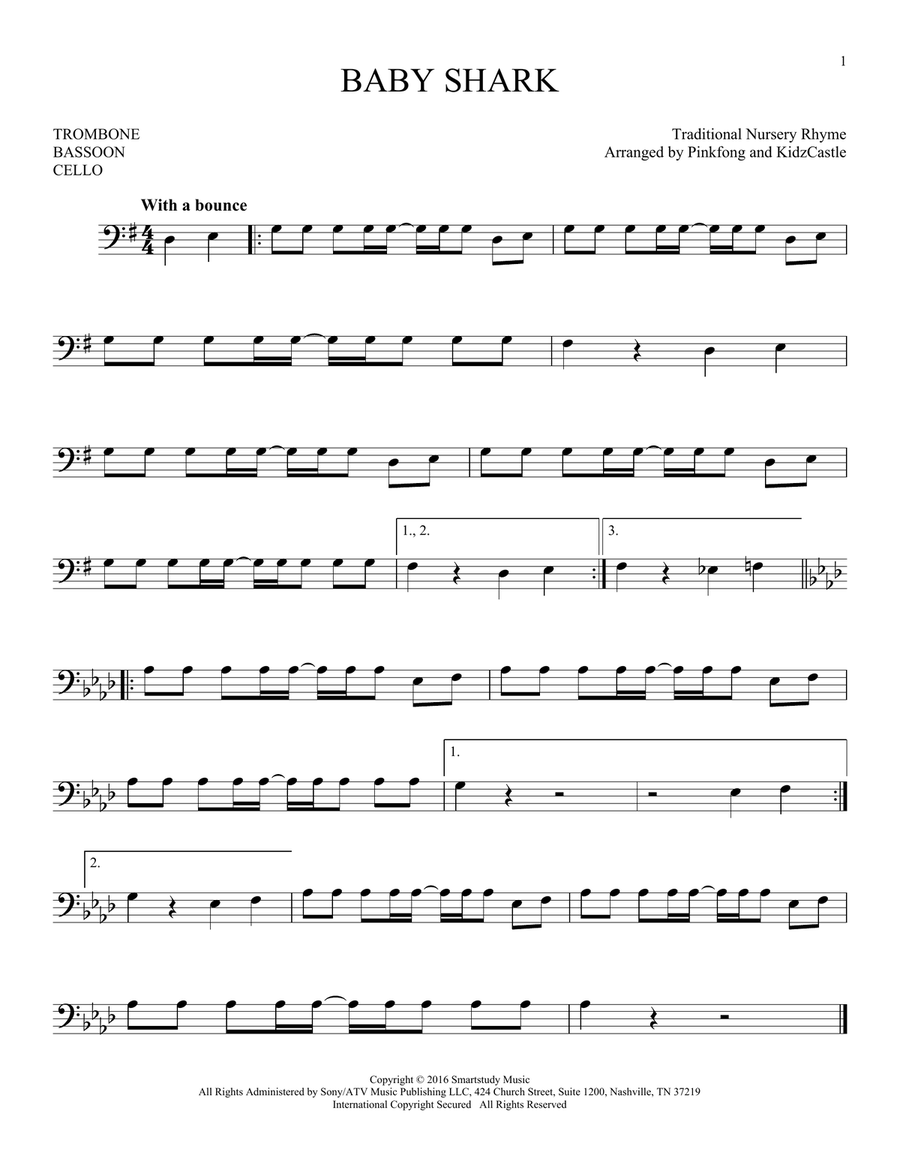
As of 2026, Baby Shark remains one of the most-streamed children’s songs of all time, with over 15 billion views on YouTube, making it a universally recognizable tune for young learners. This guide covers the notes for the viral children’s tune in bass clef (the correct spelling of the common query typo “base cleff” used to find this guide). The bass clef, also called the F clef, is used for lower-pitched instruments and the left hand of piano, and its simple, repetitive melody means even total new learners can master the tune quickly. We break down the exact notes, rhythm, hand position, and practice tips you need to play Baby Shark confidently, no prior music experience required.
Why Baby Shark Is the Ideal First Bass Clef Tune
The global popularity of Baby Shark, paired with its limited 6-note range and repetitive structure, makes it uniquely suited for new bass clef learners. Unlike more complex beginner pieces, the simplified arrangement of Baby Shark sits entirely within the 5-line bass clef staff, so you won’t need to learn ledger lines (extra lines for notes outside the staff) for the first several practices. For young children, the familiar melody keeps engagement high, while adult beginners appreciate the low-stakes, fast payoff. The CDC notes that regular, low-pressure music exposure for young children supports language development, fine motor skills, and emotional regulation, making simple, repetitive tunes like Baby Shark an ideal starting point for musical learning. You can also read our guide on sassy baby toys developmental set.
Core Bass Clef Basics You Need to Know
Before diving into the notes, a quick refresher on bass clef fundamentals will set you up for success.
What Is the Bass Clef (F Clef)?
The bass clef gets its alternate name, the F clef, from the F note (the F below middle C) that the clef’s two curved dots wrap around on the 4th line of the staff. For piano players, the bass clef is almost always used for the left hand, covering the lower range of the instrument. The 5 lines of the bass clef staff, from bottom to top, correspond to the notes G, B, D, F, A (mnemonic: Good Boys Do Fine Always), while the 4 spaces between the lines are A, C, E, G (mnemonic: All Cows Eat Grass). For context, the table below highlights the key differences between bass and treble clef, the two most common clefs for beginner musicians:
| Clef Type | Starting Line | Primary Use | Example Note on 2nd Line |
|---|---|---|---|
| Bass Clef (F Clef) | 4th line (F below middle C) | Lower-pitched instruments, piano left hand | B |
| Treble Clef (G Clef) | 2nd line (G above middle C) | Higher-pitched instruments, piano right hand | G |
| For a full breakdown of standard clef notation, refer to the Royal Academy of Music’s official glossary. You can also read our guide on safety first thermometer fast read. |
Common Bass Clef Misconceptions
Many new learners assume middle C sits inside the bass clef staff, but it is actually notated on a single ledger line above the 5-line staff. The simplified Baby Shark arrangement avoids ledger lines entirely, using only the notes within the core staff to keep learning simple. Another common misconception is that bass clef is only for “hard” instruments like cello or bass guitar — in reality, it is a core skill for all piano players, as the left hand almost always reads bass clef.
Exact Bass Clef Notes for Baby Shark (Simplified Beginner Arrangement)
The arrangement below matches the standard simplified version of Baby Shark taught to young beginners, in the key of G major and 4/4 time (the time signature of the original Pinkfong track) at approximately 115–120 BPM. All notes sit within the bass clef staff, no ledger lines required.
Note-by-Note Breakdown With Lyrics
Each note in the melody corresponds directly to a syllable of the "Baby Shark" verse, making it easy to memorize the sequence by singing along to the familiar tune. Use the table below to match lyrics to notes, staff position, and recommended left-hand fingerings for piano:
| Lyric | Bass Clef Note | Staff Position | Left-Hand Fingering | Mnemonic |
|---|---|---|---|---|
| Baby | G | 2nd line | Pinky (5) | "Good" Boys |
| Shark | A | 2nd space | Ring (4) | All Cows |
| Doo | B | 3rd line | Middle (3) | Do Fine |
| Doo | C | 3rd space | Index (2) | Always Eat |
| Doo | D | 4th line | Thumb (1) | — |
| Doo | E | 4th space | Pinky (5, small stretch) | — |
| For non-piano bass clef instruments, adjust fingerings to match your instrument’s range: for example, cellists will play these notes on the A and D strings, while bass guitarists will use the E and A strings. |
Rhythm and Timing Guide
One of the most common mistakes new learners make is ignoring rhythm, playing all notes as equal quarter notes. The correct rhythm for the first "Baby Shark" phrase is:
- "Baby" and "Shark" = 1 quarter note each (1 full beat per syllable)
- Each "doo" = 1 eighth note (½ beat per syllable)
This adds up to 4 total beats per phrase, fitting perfectly into 4/4 time. Count along as you practice: "1 (Baby) 2 (Shark) 3-and 4-and (doo doo doo doo)" to stay on beat.
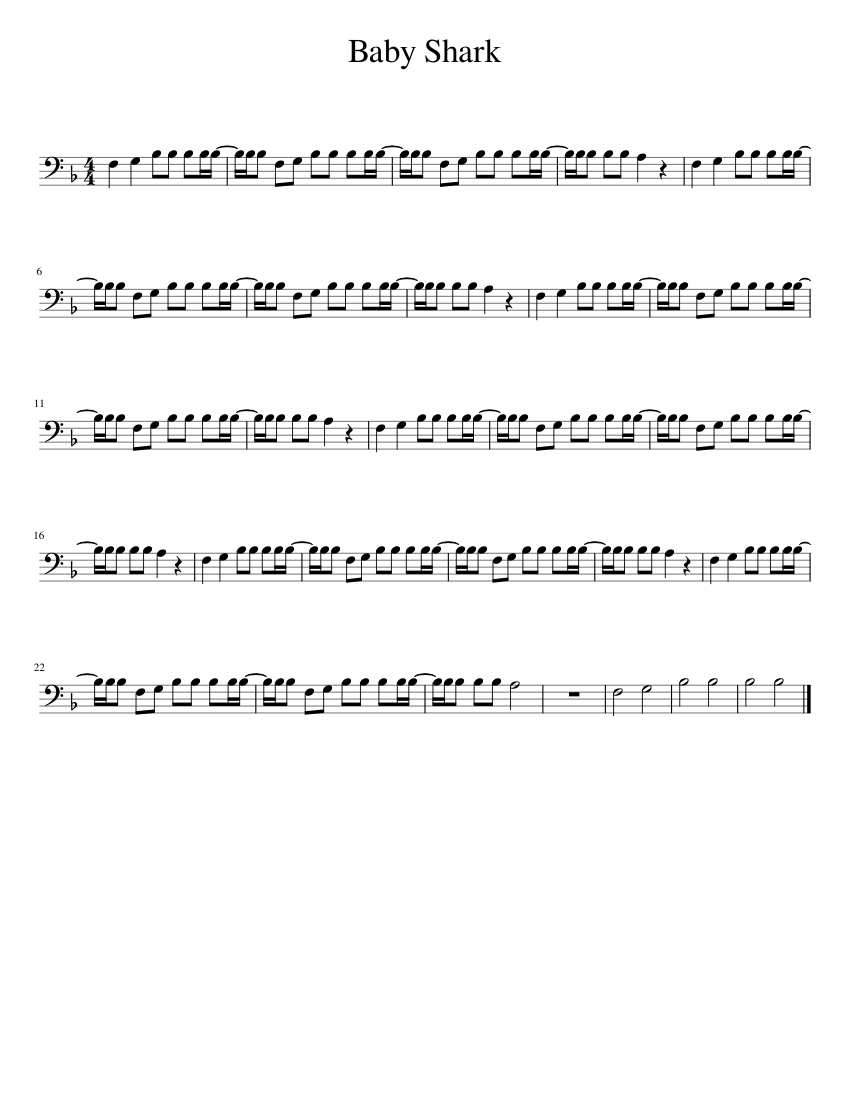 Simplified single-staff bass clef arrangement for beginner piano players, no ledger lines required
Credit: musescore.com
Simplified single-staff bass clef arrangement for beginner piano players, no ledger lines required
Credit: musescore.com
Step-by-Step Playthrough for Bass Clef Instruments
Hand Position Setup (Piano Focus)
For piano players, start by positioning your left hand so your pinky rests on the G note on the 2nd line of the bass clef staff (the G below middle C). Your ring finger will sit on A, middle on B, index on C, and thumb on D. The final E note on the 4th space requires a small, comfortable stretch for your pinky — if this feels tense for young learners, shift your hand slightly to reach E, or practice only the first 3 notes (G, A, B) for the first week to build flexibility. For other bass clef instruments, position your hand/ fingers to comfortably reach the G to E range without straining. For young learners, a small-sized beginner keyboard is a great starting point, as it is sized for small hands and has clearly marked keys to reduce confusion.
First Practice Attempt
Follow these steps for your first practice session:
- Play each note individually, saying the corresponding lyric out loud to build the note-lyric association.
- Add the rhythm, using a free metronome app set to 60 BPM (half the speed of the original track) to avoid rushing.
- Play the full 4-beat phrase 4 times in a row to match the full "Baby Shark" verse.
 Hal Leonard's simplified edition removes complex notation for young learners
Credit: www.noty.online
Hal Leonard's simplified edition removes complex notation for young learners
Credit: www.noty.online
Common Mistakes Beginners Make
Learning bass clef comes with a few common hurdles, especially for new readers. Avoid these pitfalls to progress faster:
- Mixing up bass and treble clef note positions: A common error is playing the 2nd line of the bass clef as G (the treble clef 2nd line) instead of B. To fix this, memorize the bass clef mnemonics (Good Boys Do Fine Always for lines, All Cows Eat Grass for spaces) and quiz yourself on note positions before playing the tune.
- Rushing the eighth-note "doo" syllables: Beginners often play all notes as equal quarter notes, which makes the tune sound choppy and off-beat. Practice counting out loud during each phrase to lock in the ½-beat rhythm for the "doo"s.
- Over-stretching the hand to reach E: The small stretch from D to E can cause tension for young children. If this is an issue, shift your hand slightly to the right to reach E, or practice only the first 3 notes for the first 1–2 weeks to build flexibility.
- Accidentally playing middle C: Middle C is a ledger line above the bass clef staff, not part of the core 5-line staff. Double-check that you are playing the G on the 2nd line, not the middle C above the staff, for the first note of the phrase.
4-Week Practice Plan to Master the Tune
Consistency is far more important than long practice sessions, especially for young learners. Follow this low-pressure plan to master Baby Shark in bass clef in 4 weeks, with just 5–10 minutes of practice per day:
Week 1: Note and Fingering Fluency
Focus only on playing the 6 notes in order (G → A → B → C → D → E) with correct fingerings, no rhythm required. Say each note name out loud as you play to build muscle memory.
Week 2: Rhythm and Timing
Add the 4/4 rhythm, using a metronome set to 60 BPM. Count out loud for each phrase, and focus on playing the "doo" syllables as eighth notes (½ beat each).
Week 3: Speed and Consistency
Increase the metronome to 100 BPM, and practice playing 4 full verses in a row without stopping. If you make a mistake, slow the metronome back down and practice the tricky phrase 5 times before continuing.
Week 4: Play Along With the Original Track
Increase the tempo to 115–120 BPM to match the original Pinkfong version, and play along to test your timing. Add simple dynamics: play the "Baby Shark" and "Shark" syllables slightly louder, and the "doo" syllables softer, to make the tune more musical.
For busy parents, fit these short sessions around nap schedules to avoid disrupting your child’s rest. Practice in a calm, quiet space, like a cozy corner of the nursery, to help young learners stay focused.
 Full notation including rhythm markings and dynamic cues for practice
Credit: musescore.com
Full notation including rhythm markings and dynamic cues for practice
Credit: musescore.com
Frequently Asked Questions
What are the actual bass clef notes for Baby Shark?
The simplified beginner arrangement uses G (2nd line), A (2nd space), B (3rd line), C (3rd space), D (4th line), and E (4th space) in the bass clef staff, no ledger lines required for the main melody.
Is Baby Shark easier to play in bass clef or treble clef?
For total beginners, the bass clef version is often easier, as the full melody fits within the 5-line staff with no ledger lines. The treble clef version typically requires middle C, a ledger line above the staff, which adds an extra hurdle for new readers.
What bass clef instruments can use these notes?
These notes work for piano left hand, cello, bass guitar, trombone, tuba, and any other F-clef instrument with a range that covers the G below middle C to the E above that G.
Can I transpose Baby Shark to a different key for bass clef?
Yes — if the G major range is too high or low for your instrument, you can transpose the melody up or down an octave, or adjust string/fret positions for fretted instruments, without changing the rhythm or melody structure.
What tempo should I play Baby Shark at as a beginner?
Start at 60 BPM for your first practices, and gradually increase to 115–120 BPM (the speed of the original Pinkfong track) once you can play the full phrase without mistakes.
Next Steps for Bass Clef Beginners
Once you’ve mastered Baby Shark, you can build on your skills with other simple G major tunes like Twinkle Twinkle Little Star or Happy Birthday, which use many of the same notes you’ve already learned. The pattern recognition and fine motor control built from learning this tune will also support other early childhood developmental milestones, like self-care tasks and early literacy. For more low-pressure musical play ideas for young kids, check out our guide to age-appropriate developmental play to keep learning fun. If you’re looking to build your bass clef fluency even faster, our guide to daily bass clef warm-up routines will help you master note positions and fingerings in just 10 minutes a day.
Conclusion
Mastering the bass clef notes for Baby Shark is an achievable goal for even total beginner musicians, with consistent, low-pressure practice. The tune’s repetitive melody and familiar tune make it a low-stakes way to build core bass clef literacy, finger strength, and rhythm skills that will serve you well as you learn more complex pieces. Don’t rush the process — focus on playing each note correctly and keeping steady time, and you’ll be playing the full tune confidently in less than a month. For extra practice, play along with the official Pinkfong track here to test your timing and have fun.
Sophia Linda is a freelance writer and Certified Health Coach based in the Newbury Park, CA. Passionate about healthy living, she focuses on helping families stay active and connected to the outdoors. Together with her husband and their three young children, Sophia spends much of her time traveling, hiking, and camping. Her work has been featured on the bestbabycart blog, and she brings a practical, real-world perspective to reviewing baby products for parents.