
If you’re wondering when your child can stop using a car seat, you’re not alone: 62% of parents report confusion over size-based milestones and state-specific legal requirements, per 2026 National Highway Traffic Safety Administration (NHTSA) data. This guide aligns with the latest NHTSA and CDC guidance to walk you through exact age, height, and weight thresholds, common safety mistakes, and how to confirm your child is ready for a standard seat belt. We’ll also share free resources to get a professional car seat inspection in your area.
Core Car Seat Safety Principles
Car seat requirements are not arbitrary: they are built on decades of crash data showing that properly fitted restraints reduce fatal injury risk by 71% for infants and 54% for toddlers in passenger cars NHTSA child passenger safety guidelines. While age is often used as a rough baseline for laws, your child’s height and weight are far more important determinants of readiness, as they directly impact how well a seat belt or harness fits during a crash.
All 50 U.S. states require child passenger restraints, but thresholds vary widely. The overarching priority across all guidelines is to keep children in the most protective restraint possible for as long as they fit, rather than rushing transitions for convenience.
Age & Size Milestones for Each Car Seat Stage
Car seats are designed for specific size ranges, not just age groups. Transitioning too early is one of the most common and dangerous mistakes parents make. Below are the 2026 recommended milestones for each stage:
Rear-Facing Car Seats (Infants to Toddlers)
Rear-facing seats are the safest option for young children, as they support the head, neck, and spine during a crash, reducing strain on these vulnerable areas by 5x compared to forward-facing seats. Keep your child rear-facing for as long as possible, until they hit the maximum height or weight limit listed on their seat label.
- Infant bucket seats typically have a limit of 30–35 lbs and 32 inches, which most children outgrow at 12–18 months.
- Convertible car seats allow children to stay rear-facing up to 40–50 lbs and 40 inches, usually until age 2–3. Many parents make the mistake of switching to a forward-facing seat as soon as their child outgrows an infant bucket, even if their convertible seat still supports rear-facing use.
Forward-Facing Car Seats with Harness (Toddlers to Preschoolers)
Once your child outgrows the rear-facing limit of their seat, transition to a forward-facing seat with a 5-point harness. Keep them in this stage until they hit the seat’s maximum height or weight limit, usually 65 lbs and 57 inches, or around age 4–7. The harness should sit at or just above your child’s shoulders, with the chest clip positioned at armpit level.
Booster Seats (Preschoolers to Pre-Teens)
Booster seats elevate children so the vehicle’s seat belt fits correctly across their body, rather than the neck or stomach. Most children transition to a booster once they outgrow their forward-facing harness seat, usually at 40+ lbs and 40+ inches, around age 4–7.
- High-back boosters are recommended for most children, as they provide side-impact protection and head support for vehicles with low seat backs or no built-in headrests.
- Backless boosters are only safe for use in vehicles with a high seat back and adjustable headrest, and only if the seat belt fits properly across the chest and hips.
Standard Seat Belts (Pre-Teens to Teens)
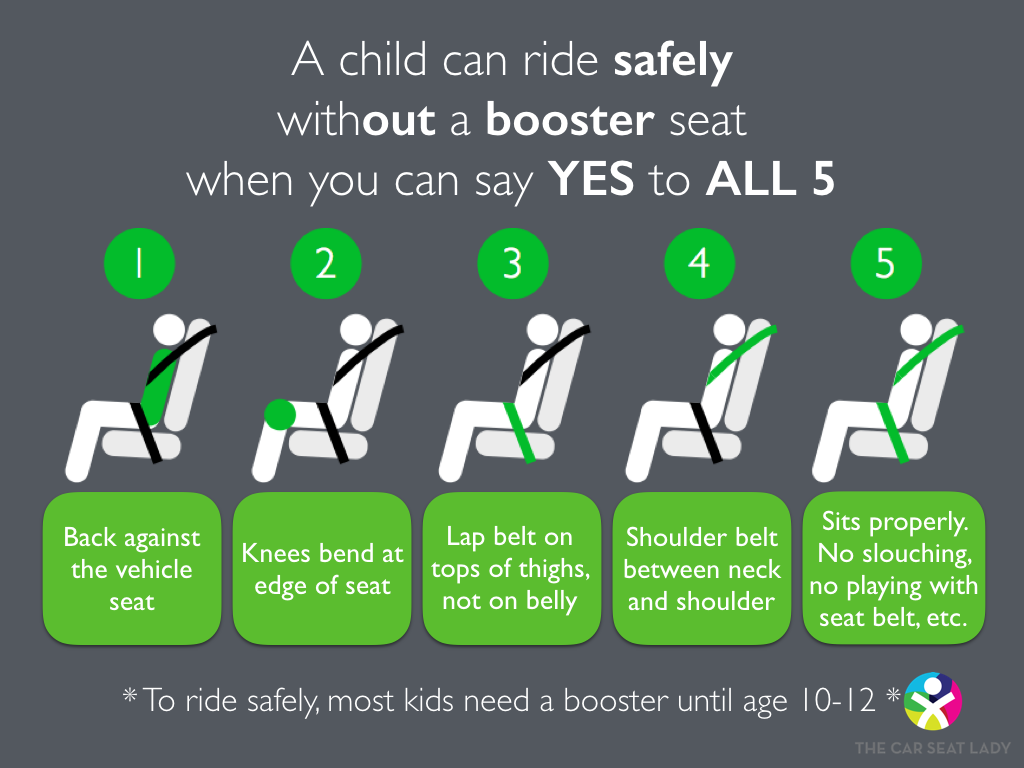
Children can use a standard vehicle seat belt without a booster only when they meet all of the following criteria, regardless of age:
- They are at least 4 feet 9 inches tall (typically between ages 8 and 12)
- Their back rests flat against the vehicle seat
- Their knees bend comfortably at the edge of the seat without slouching
- The lap belt sits low across the upper thighs, not the stomach
- The shoulder belt crosses the middle of the chest and shoulder, not the neck or face
- They can sit in this position properly for the entire ride, without slouching or moving the belt out of position
Maturity also matters: children who fidget, lean forward, or play with the seat belt are not ready to transition out of a booster, even if they meet the height requirement.
2026 U.S. State-by-State Car Seat Laws
While federal guidance from the NHTSA and CDC sets best practice standards, car seat laws are set at the state level, so requirements vary depending on where you live. Below is a breakdown of common state thresholds:
| State Category | Minimum Rear-Facing Requirement | Minimum Forward-Facing Harness Requirement | Minimum Booster Seat Requirement |
|---|---|---|---|
| Most U.S. states | Age 2 (or until seat height/weight limit) | Age 4 (or until seat height/weight limit) | Age 8 or 4’9” tall, whichever comes first |
| Strict states (CA, NY, TX, etc.) | Age 2 (or 40 lbs, whichever comes first) | Age 4 (or 65 lbs, whichever comes first) | Age 8 and 4’9” tall, or 80 lbs, whichever comes first |
| Lenient states (FL, AZ, etc.) | Age 1 (or 20 lbs, whichever comes first) | Age 4 (or 40 lbs, whichever comes first) | Age 5 or 40 lbs, whichever comes first |
Penalties for non-compliance range from $25 to $500 in fines, plus points on your driver’s license in some states. Most states offer exemptions for children with documented medical conditions that prevent them from using standard restraints, but you will need a note from your child’s pediatrician to qualify.
Laws also vary for rideshare and taxi use: 34 states as of 2026 exempt these vehicles from car seat requirements, but safety experts strongly recommend using a portable car seat for any ride with young children, regardless of legal exemptions.
Common Car Seat Mistakes That Reduce Safety
Even parents who follow age guidelines often make avoidable errors that compromise safety. These are the most frequent pitfalls:
- Using bulky winter coats under the harness Puffy jackets create slack in the harness straps, so in a crash, a child can slip out of the seat. Instead, dress your child in thin, close-fitting layers, buckle the harness, then put the coat on backwards over the straps. For guidance on age-appropriate winter layering that won’t interfere with harness fit, check our winter coat sizing guide.
- Installing the seat too loose The seat should move less than 1 inch side-to-side when you pull at the base. Many parents fail to tighten the seat belt or LATCH system enough, or use seat belt paths incorrectly for their vehicle model.
- Transitioning to the next seat too early Rushing to move a child to a forward-facing seat or booster for convenience increases injury risk. Always follow the height and weight limits listed on your seat’s label, not just age recommendations.
- Using an expired or crash-damaged seat Car seats expire 6–10 years after manufacture, as the plastic degrades over time and exposure to extreme heat and cold weakens structural integrity. Any seat involved in a moderate or severe crash must be replaced, even if there is no visible damage. Unsecured car seats can also become dangerous projectiles in a crash, so always buckle the seat in even when your child is not riding in it; learn more about the risks of unsecured car seats.
- Improper seat belt fit in boosters The shoulder belt should never be tucked under the arm or behind the back, and the lap belt should never rest on the stomach. These errors can cause severe internal injuries in a crash.
How to Confirm Your Child Is Ready for a Seat Belt
Many parents assume their child is ready for a seat belt once they hit age 8, but the only way to confirm readiness is to complete the 5-step seat belt fit test:
- Your child sits all the way back against the vehicle seat
- Their knees bend comfortably at the edge of the seat without slouching
- The lap belt sits low across the upper thighs, not the stomach
- The shoulder belt crosses the middle of the chest and shoulder, not the neck or face
- They can sit in this position properly for the entire ride
If your child fails any of these steps, keep them in a booster seat. If you’re planning road trips to test your child’s seatbelt readiness, our guide to managing early bedtimes on outings can help keep tired kids safe and comfortable during long drives. All children under 13 should ride in the back seat, as front airbags can cause severe injury to younger passengers even when seat belts are worn correctly.
Free Resources for Car Seat Safety Checks
Proper installation is just as important as choosing the right seat for your child’s size. The NHTSA offers a free, searchable locator tool for certified car seat inspection stations at fire departments, police stations, and hospitals across the U.S. Many pediatrician offices also offer free checks during well-child visits.
If you’re traveling with multiple pieces of baby gear, learning quick stroller folding can make loading and unloading the car faster and reduce stress during transitions. For long road trips to test your child’s seatbelt readiness, packing extra travel cloth diapers for younger siblings can cut down on unnecessary stops and keep everyone comfortable.
Most car seat manufacturers also offer free online video tutorials for specific models, and many local community centers host free car seat safety workshops for parents.
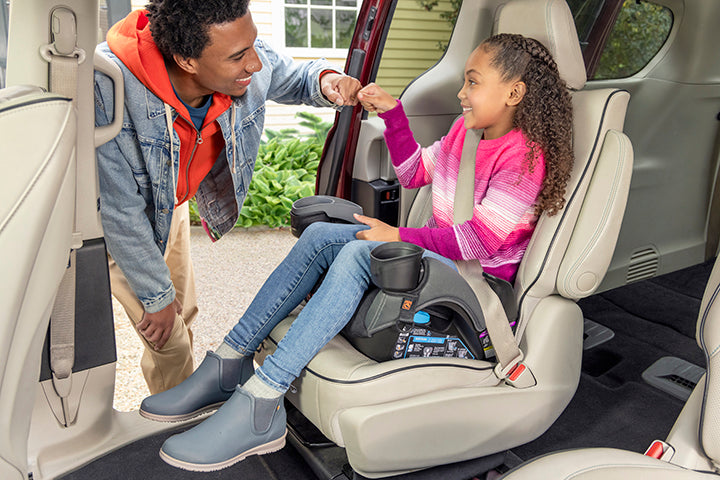 This Evenflo model is suitable for infants up to 50 lbs in rear-facing mode
Credit: www.evenflo.com
This Evenflo model is suitable for infants up to 50 lbs in rear-facing mode
Credit: www.evenflo.com
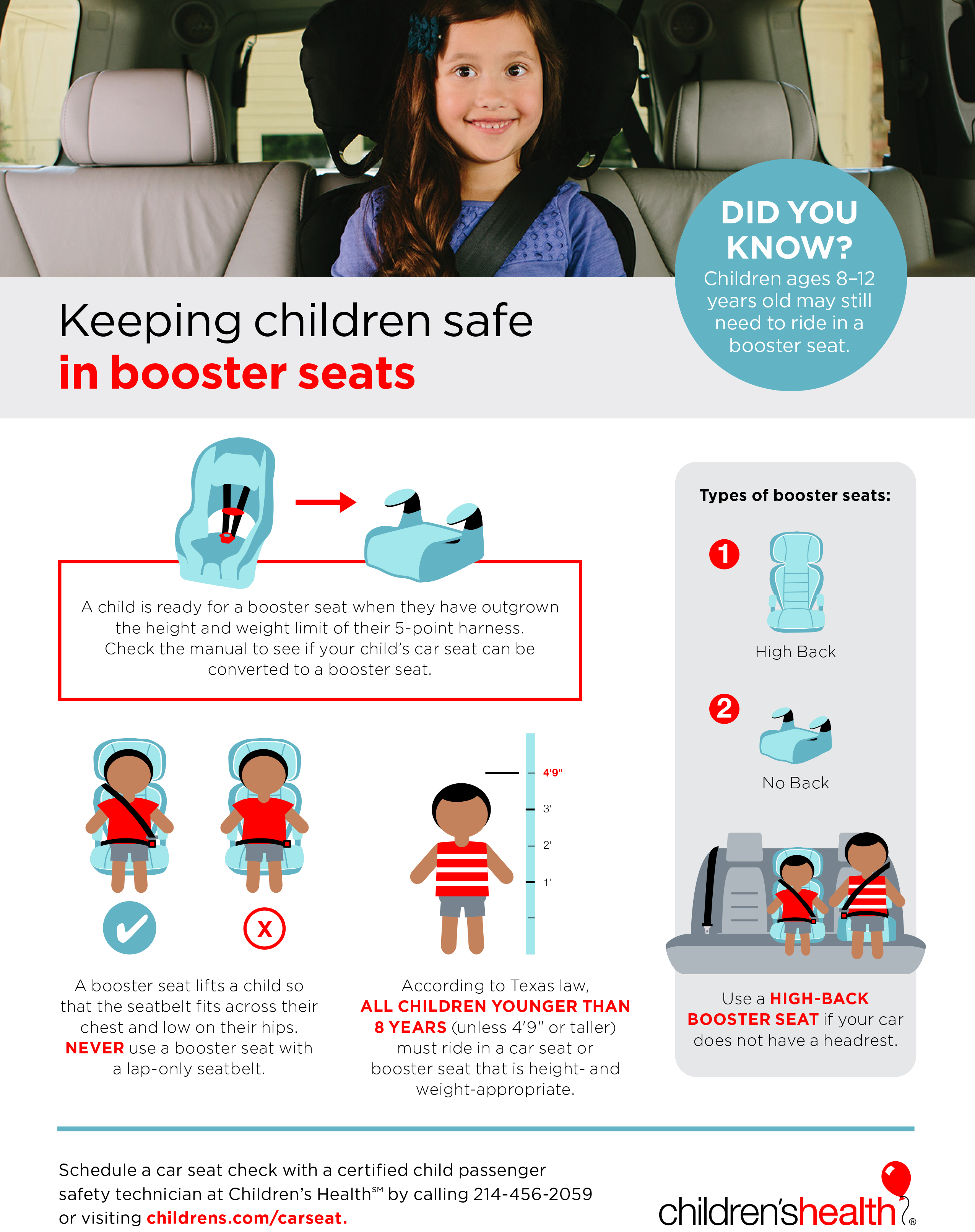 Printable guide from Children’s Health outlining car seat transitions by size
Credit: www.childrens.com
Printable guide from Children’s Health outlining car seat transitions by size
Credit: www.childrens.com
 Official CDC 2026 recommended car seat stages for U.S. children
Credit: 1800lionlaw.com
Official CDC 2026 recommended car seat stages for U.S. children
Credit: 1800lionlaw.com
Frequently Asked Questions
When can a child stop using a car seat entirely?
There is no universal age: the only requirement is that your child is at least 4 feet 9 inches tall, can sit all the way back against the vehicle seat with knees bent at the edge, and the seat belt fits snugly across the chest and upper thighs (not the neck or stomach). This typically happens between ages 8 and 12, but varies by child. Always check your state’s specific laws, as some mandate booster use until age 8 regardless of height.
Is a backless booster seat safe for young kids?
Backless boosters are safe only if your vehicle has a built-in high seat back and headrest that supports the child’s head and neck, and the seat belt fits properly across the chest and hips. They are not suitable for vehicles with low seat backs or no headrests, as they offer no side-impact protection.
Can I use a car seat that’s been in a minor crash?
No: any car seat involved in a moderate or severe crash must be replaced, even if there is no visible damage. For minor fender-benders (under 10 mph, no airbag deployment, no one in the vehicle was injured, and the car seat shows no visible damage), some manufacturers allow reuse, but check your seat’s manual for specific guidance.
Do car seat laws apply to rideshare and taxis?
Laws vary by state: 34 states as of 2026 exempt taxis and rideshare vehicles from car seat requirements, but safety experts strongly recommend using a portable car seat for any ride with young children, regardless of legal exemptions.
Conclusion
Your child’s safety on the road is non-negotiable, and taking the time to confirm they’re in the right restraint for their size is one of the most impactful things you can do to protect them. Rather than focusing on age alone, prioritize height and weight thresholds, double-check your state’s current legal requirements, and schedule a free car seat inspection to confirm your installation is correct. For the most up-to-date state-specific requirements and inspection station locations, visit the NHTSA’s official child safety page today.

Emma Grace is a devoted mother and passionate content writer at BestBabyCart.com. With firsthand parenting experience and a love for research, she creates helpful guides and honest reviews to support parents in choosing the best for their babies. Her goal is to make parenthood easier, one article at a time.