
You've probably buckled the waist band, hoisted the baby in, and thought, "looks good, let's go." That's exactly where a soft structured carriers checklist earns its keep. "Feels right" hides a dozen small mechanical failures that only surface once the baby starts shifting weight.
Per ASTM F2236-21, the US consumer safety standard for child carriers, a passing unit must maintain two finger-widths of chin-to-chest clearance at all times. Miss that gap and the airway is compromised. Here's the full pre-wear workflow that keeps both of you safe.

Image source: Web (Bing) / newmodernmom.com (Web image (fair-use with source credit))
Quick Answer
A soft structured carriers checklist is a step-by-step safety check. You run it before every wear session. It covers hardware, straps, hip geometry, and airway clearance.
Per ASTM F2236-21, the minimum chin-to-chest gap is two adult finger-widths. The full sequence takes 60 to 90 seconds.
Why "Feels Right" Isn't a Safety Check: What the Checklist Actually Catches
The problem isn't that you don't know how to buckle a carrier. It's that "tight" and "snug" mean different things to every carer. The checklist exists because specific mechanical failure points don't announce themselves.
They quietly shift your baby's airway or hip angle by a few degrees.
In aggregate CPSC incident data, the top three carrier-related injuries involve airway compression, hip subluxation from poor P-position, and carer shoulder strain. All three trace back to skipped micro-steps in the fitting sequence.
If you've only done a carrier a handful of times, you've probably relied on the "I can see their face" test. That's a start. It's not a safety system.
The checklist breaks verification into distinct gates that you clear in order:
- Hardware integrity: every buckle clicks, no seam is frayed, foam core is intact
- Strap geometry: 45-degree angle landing on the deltoid, not the trapezius
- Hip slot engagement: knees above the bottom, legs straddling the panel
- Airway corridor: two-finger gap between baby's chin and your sternum
- Post-settle re-tension: fabric micro-stretches in the first 90 seconds, straps drift
Miss any one gate and the downstream position is compromised. The same invisible-risk logic that keeps a toddler away from an open window applies here. You can't see a 3-degree hip rotation change from across the room.
The checklist turns a hope into a repeatable 60-second workflow. You run it before you step out the door, not after you've walked three blocks.
What Changes Based on Baby's Age, Insert Use, and Carry Position
This is where the decision tree branches. The same physical carrier, the same checklist, but the conditions change what you're verifying.
If the baby is under 3 months, you're running the newborn branch. A structured insert is mandatory. The baby rides front inward only.
The insert fills the gap between the baby's head and your chest so the chin doesn't drop to the sternum. Per IHDA guidance, the hip-healthy P-position matters most in this window because the acetabulum is still shaping.

Image source: Web (Bing) / babyplannersg.com (Web image (fair-use with source credit))
At 4 to 6 months, head control is established. You can unlock the hip carry and front outward position. The insert comes out.
The checklist adds one extra gate: verify the baby's chin clears your collarbone, not your chest.
At 6 months and beyond, back carry becomes the primary position. The two-second ear rule activates. Your ear should sit at least two inches above the baby's ear.
The panel must reach above their shoulder blades.
As of 2026, most manufacturers gate front outward at 4 months minimum, but the AAP recommends waiting until the baby holds their head steady without support. When you're ready to flip them face-out, the same logic that governs when a baby can face forward in a car seat applies. Head control first.
No exceptions.
If the carer is under 5 feet, the panel may be too long. Straps won't cross properly. Verify the waist band hits the iliac crest, not the hip.
If you're over 5 feet 8, check the panel reaches high enough on the back to support the lumbar curve.
Pre-Wear Inspection: Hardware, Seams, and Panel Integrity
Before you even lift the baby, you're checking the carrier itself. This takes 15 seconds and catches the failures that no amount of strap tensioning fixes.
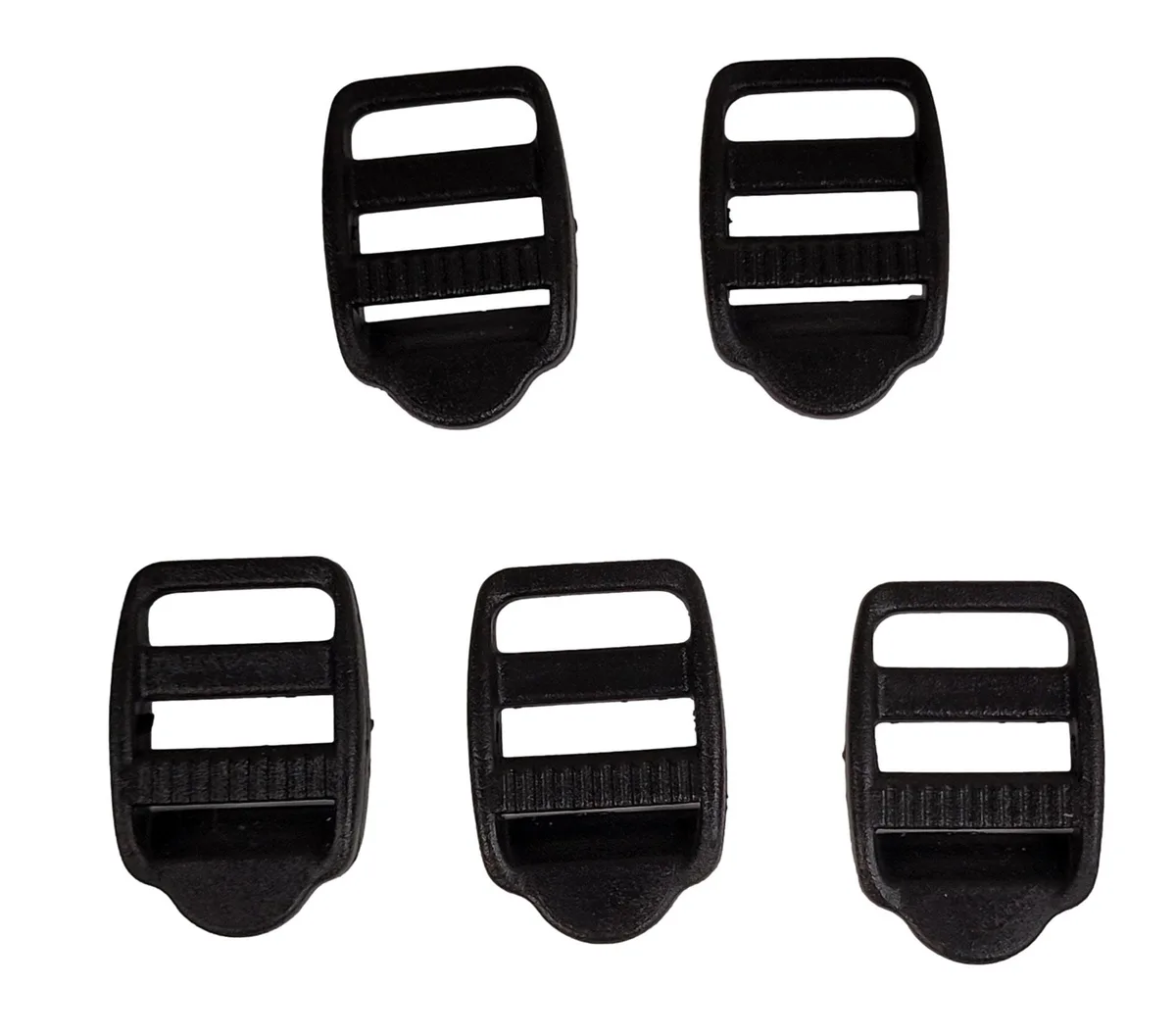
Image source: Web (Bing) / musmate.co.uk (Web image (fair-use with source credit))
Run your fingers along every seam. You're looking for:
- Frayed thread at hip-slot edges (the fabric is about to delaminate)
- A buckle that clicks but doesn't lock (push the tab in and try to open it by hand)
- Ladderlock toggles that seize or skip a row after 12 or more wet cycles
- Foam core compression: press the back panel. If it springs back slowly or has a permanent dent, structural support is degraded
Tug-test the shoulder straps at the stitching point where they meet the panel. You want zero give. A quarter-inch of play means the load is transferring to the thread, not the fabric.
Per ASTM F2236-21, a carrier that fails the structural integrity test is out of service, full stop. The standard doesn't grandfather in "it still looks fine." If a seam is splitting, the carrier is retired.
The same expiry logic that governs how long a car seat stays road-legal applies to your SSC. Fabric stretches. Foam compresses.
Hardware fatigues. Most manufacturers rate a 3-to-5-year service life with regular washing and UV exposure. Past that, the material is just waiting to fail.
Store the carrier flat or hung, not bunched in a bag. Wipe moisture off hardware before it corrodes the buckle pins. Air-dry only.
A tumble dryer cooks the foam core and makes it brittle within two cycles.
The Fitting Sequence: Lock, Thread, Set, Place, Re-Tension
This is the core workflow. You do it in order. Skipping ahead breaks the chain.
Step 1: Waist Band and Core Lock
Slide the waist band to your navel or just above. Click the buckle. Pull the slack out by yanking the free ends downward.
The band should sit flat against your lower torso, not riding up on your ribs.
Step 2: Shoulder Straps at 45 Degrees
Thread both straps through the back panel. Clip the hardware. Pull down and outward until the straps land at a 45-degree angle on your deltoid.
If they're riding on your trapezius, the panel is too low. Add one more row of tension.
Step 3: Height and Panel Tension
Set the hip slot height so the baby's bottom sits at your navel level. For a back carry, the panel should reach above the shoulder blades. Tighten the back toggle until the panel is snug against your spine.
You should feel the foam core, not fabric stretch.
Step 4: Placing the Baby
Slide the baby in from the side. Let their weight settle for two seconds. Spread the knees to the panel edge.
The hips should wrap around the fabric, not dangle below it. For newborns with an insert, the head cradle should tuck under the baby's chin.
Step 5: Final Re-Tension and the 90-Second Re-Check
After the baby settles, the fabric micro-stretches. Re-pull the shoulder straps. Re-click the waist buckle if it's shifted.
Walk three steps. Bounce gently. If the baby slips below the panel edge or the chin drops to the chest, you're not done.
Tighten and re-verify.
The whole sequence, done deliberately, takes 60 to 90 seconds. If you're cutting it to 15 seconds because you're rushing to the car, you're not running a checklist. You're running a prayer.
Post-Placement Verification: M-Shape, Airway Gap, and the Ear Rule
You've placed the baby. Now you verify the geometry. This is the step most people skip because they think "I just did that." You didn't.
You placed the baby. You haven't confirmed the physics.
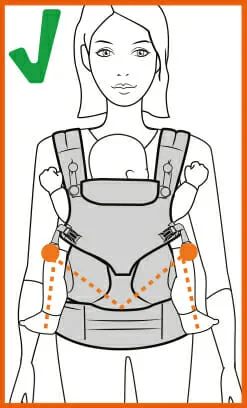
Image source: Web (Bing) / ergobaby.com.au (Web image (fair-use with source credit))
Front Inward and Hip Carries
Look down. The baby's knees should be higher than the bottom. The thighs should be spread, not compressed.
The International Hip Dysplasia Association calls this the M-shape, or P-position. If the legs are hanging straight down past the panel, the hip slot is too wide for this baby's proportions. A narrower panel model or a properly fitted insert solves that.
Slide two fingers between the baby's chin and your sternum. You should feel a full gap. No pressure.
No chin-on-chest contact. This is the same principle behind choosing the safest crib mattress to prevent SIDS. The airway must remain unobstructed at every angle the head can fall.
Back Carries and the Two-Second Ear Rule
Turn and look over your shoulder. Your ear should sit at least two inches above the baby's ear. If they're level, the panel is too low or the straps have sagged.
Adjust up one row.
Check the baby's face from behind. You should see their cheek, not the back of their head. If you can't see the face, the airway is buried in the panel.
For thermal context: if the baby's back feels hot to the touch but yours is cool, you're over-bundling. Learn to read temperature cues correctly and layer accordingly. Vented mesh panels help in summer, but a fleece insert in winter can cook a baby fast.
Re-check at the 5-minute mark. Fabric settles. Straps drift.
What was tight at minute zero is loose at minute five.
The Five Mistakes That Show Up in CPSC Incident Reports and ICA Audits
You don't have to wait for a recall to learn what goes wrong. The CPSC incident database and ICA audit summaries flag the same five failures season after season.
Front outward before head control. A 10-week-old in a face-out carry can't support their own head. The chin drops. The airway closes. The ICA standard gates this position at 4 months minimum. The AAP recommends waiting until the baby holds their head steady unassisted.
Hip slots wider than the baby's thighs. If the legs dangle past the panel edge instead of straddling it, the femoral head isn't seated in the acetabulum. The P-position fails silently. A narrower panel or a properly tucked insert closes the gap.
Straps parked on the trapezius. This is the top carer complaint in aggregate reviews. The shoulder strap should hit the deltoid at 45 degrees. Park it on the upper trapezius and you get a 20-minute neck burn before the walk ends.
Skipping the 90-second re-tension. Fabric micro-stretches the moment the baby's weight loads. Straps that felt snug at placement are a half-inch loose by minute two. You re-pull them or the position drifts downward.
Wearing a carrier past structural retirement. A seam splitting at the hip slot. Foam that no longer springs back. A buckle that clicks but doesn't lock. Per ASTM F2236-21, any one of those failures voids the safety rating. The carrier is out of service.
If you've ever dealt with a baby who wakes every hour, the last thing you need is a carrier that shifts mid-carry and jostles them awake. A tight, verified fit is the first line of defense against that.
Maintenance, Storage, and When to Retire Your Soft-Structured Carrier
Wash the carrier after every 2 to 3 wear sessions, or sooner if it's soaked in spit-up. Manufacturer specs for Ergobaby, Tula, and Baby Björn all agree: machine wash cold, gentle cycle, no fabric softener. Air-dry flat.
Never tumble-dry. The heat breaks the foam core's cellular structure within two cycles.
Store it flat on a shelf or hung by the waist band on a wide hook. Don't toss it in a closet where straps fold and crease. Creased straps lose tension memory and ride higher on the shoulder than the factory geometry intended.
Keep hardware pins dry. Wipe moisture after each wear so the ladderlock doesn't seize.
Monthly, run the pre-wear inspection from earlier in this article. Check every seam. Tug every buckle.
Press the foam core. Three retirement triggers:
- A seam that splits or frays at the hip slot
- Foam that dents and stays dented
- A buckle tab that wobbles more than a millimeter when pushed in
Hit any one and the carrier is done. Cross-reference the CPSC recall database before retiring a unit still under two years old. Just like how a diaper's shelf life works, fabric and hardware have a structural expiry you can't see by eye.
For the fabric itself, a 3-to-5-year service life is the norm across the category. UV exposure from leaving it on a stroller in the sun accelerates that clock. Woven waffle knit holds up better than thin mesh, which delaminates at stitch lines faster.
Frequently Asked Questions
Can I use the same checklist for a 2-month-old and a 14-month-old?
Yes. The core sequence is identical. What changes are the conditional gates.
A 2-month-old needs the insert, front inward only, and a tighter chin-to-chest check. A 14-month-old unlocks hip and back carries. The M-shape and airway checks stay the same at both ages.
Do I need to re-check every 30 minutes, or is the initial check enough?
The initial check plus the 90-second re-tension covers most sessions. If you're past 2 hours of continuous wear, re-run the M-shape and airway gate. Long naps in the carrier are where drift sneaks in.
A 30-minute re-check is overkill for a 45-minute errand.
My carrier's straps stretched after a year. Is it still safe?
It depends. If the fabric stretches but the buckle still locks, the stitching hasn't pulled, and the 45-degree angle still lands on the deltoid, you're within normal wear. If the strap has thinned, the seam is lifting, or the hardware wobbles, retire it.
Run the pre-wear inspection and let the material tell you.
What's the difference between the ICA 5-Point Check and a manufacturer's fitting guide?
The ICA 5-Point Check is a universal minimum: airway, chin, head support, legs, distance. A manufacturer's guide is model-specific. It tells you where your particular panel's toggles sit and how many rows to add for a toddler.
Run both. The ICA check is the safety floor. The manufacturer guide is the tuning layer.

Taslima Khanam Sultana, a loving mom of three, founded BestBabyCart.com to help new parents navigate the world of baby products with ease. Her passion for making parenting simpler shines through delivering honest, unbiased reviews on must-haves like diapers, strollers, and feeding gear. Taslima’s mission is to empower families with expert tips, ensuring every product is safe and top-quality for your little one. Drawing from her own parenting journey, she’s dedicated to supporting yours!