
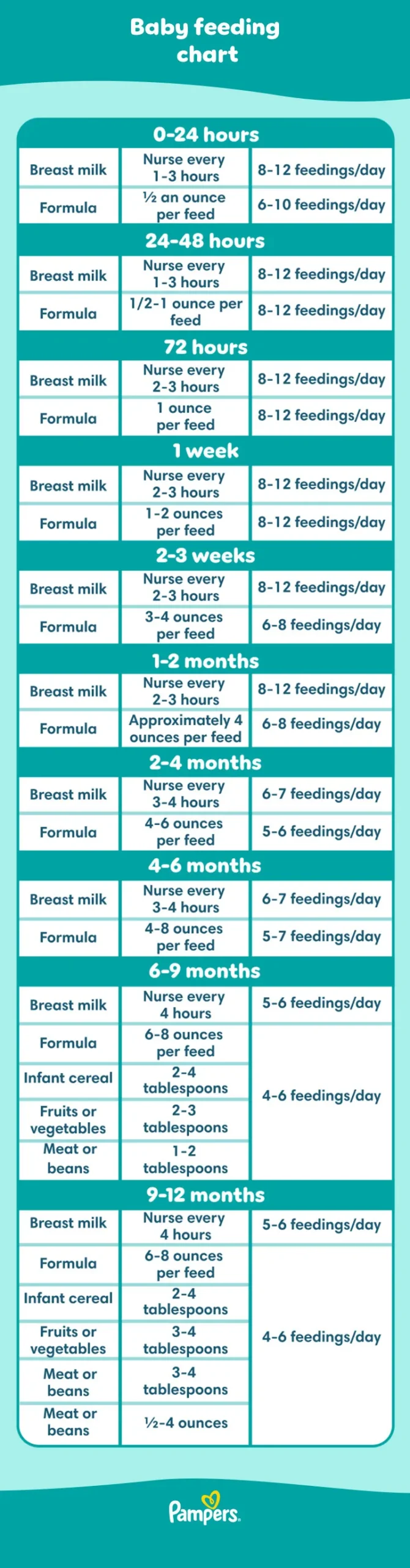
The 3-month mark is a joyful, transitional phase for new parents: the chaotic newborn haze is fading, your baby is more alert and interactive, and feeding patterns are starting to feel more predictable. But growth spurts, evolving hunger cues, and shifting sleep rhythms can make building a consistent breastfeeding routine feel overwhelming, especially if you’re balancing work, caregiving, or other family responsibilities. This evidence-based guide breaks down everything you need to create a flexible, low-stress breastfeeding schedule tailored to your 3-month-old’s unique needs, with practical tips to navigate common hurdles and support your milk supply.
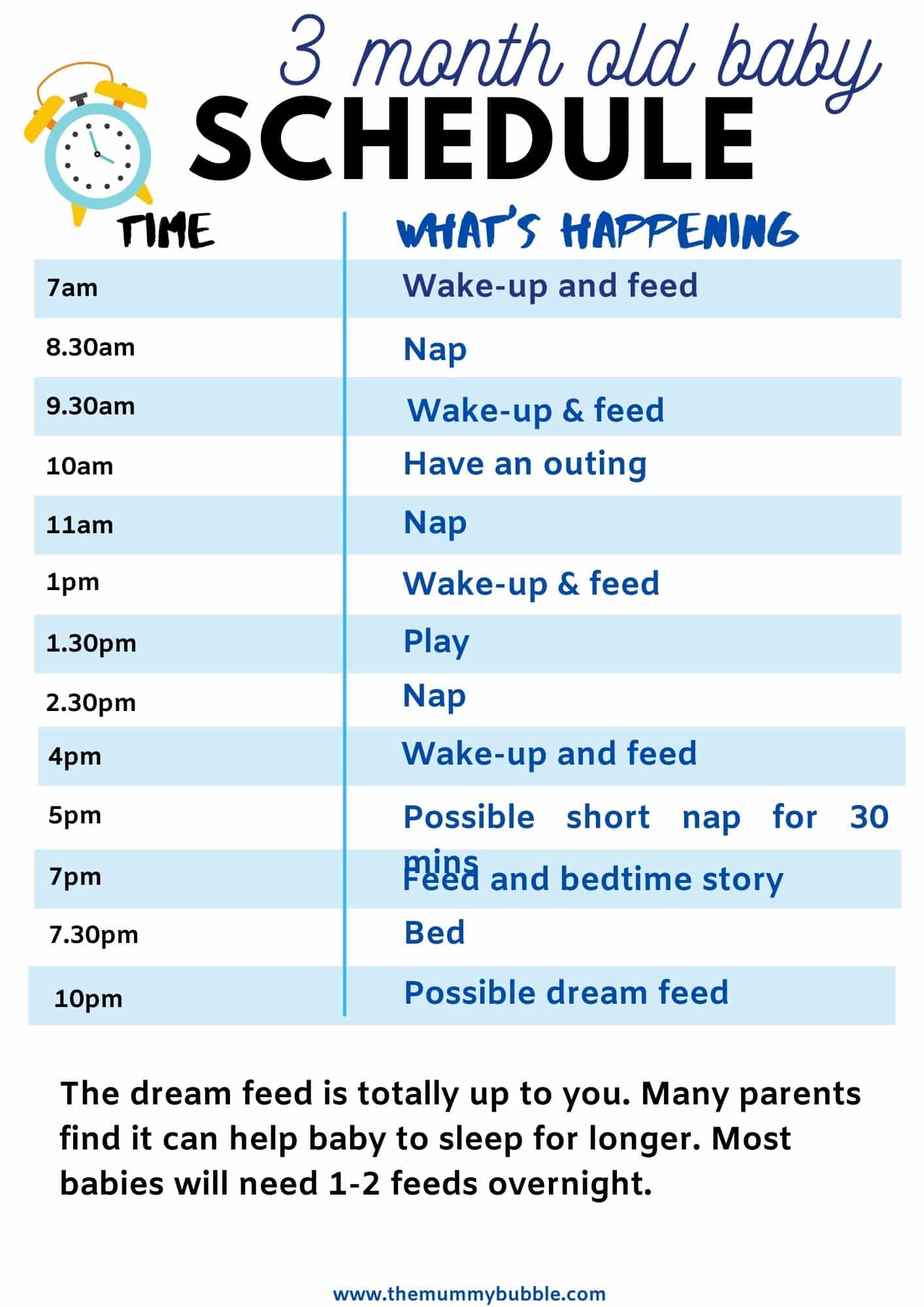 Sample daily routine incorporating flexible breastfeeding sessions for a 3-month-old
Credit: yth.org
Sample daily routine incorporating flexible breastfeeding sessions for a 3-month-old
Credit: yth.org
Core Benefits of a Consistent 3-Month-Old Breastfeeding Routine
A predictable, cue-based feeding routine does more than just ensure your baby gets enough to eat: it supports their rapid development, strengthens your bond, and creates a sense of stability for the whole family. Unlike rigid clock-based schedules, a flexible 3-month-old routine prioritizes your baby’s natural hunger signals while building a reliable framework for your days. You can also read our guide on best hospital strength double electric breast pump.
Tailored Nutrition for Rapid Development
At 3 months, breast milk composition shifts to include higher fat and calorie content to support your baby’s fast-paced brain and physical growth. As confirmed by the CDC’s official breastfeeding guidance, breast milk also provides antibodies that reduce your baby’s risk of common illnesses including ear infections, gastrointestinal bugs, and respiratory issues in their first year of life. Unlike formula, breast milk dynamically adjusts to your baby’s changing needs, so you never have to worry about switching products as they grow.
Stronger Parent-Baby Bond
At 3 months, your baby is far more interactive during feeds than they were as a newborn: they make eye contact, smile, and may even grab your finger or coo while nursing. This skin-to-skin contact releases oxytocin (the “love hormone”) for both you and your baby, reducing stress and building feelings of security and attachment. These quiet, unrushed feeding sessions are often the highlight of the day for many parents, creating core memories of early connection. You can also read our guide on how to protect baby from sun in stroller.
Predictable Rhythms for the Whole Family
A loose feeding schedule helps you plan your days around your baby’s needs, whether you’re running errands, working from home, or coordinating care with a partner or family member. For parents returning to work, a consistent routine makes it easier to transition to bottle-feeding with a caretaker while maintaining milk supply. Predictable feed times also help your baby learn to anticipate meals, reducing fussiness and making outings less stressful.
Decoding Your 3-Month-Old's Hunger Cues
At 3 months, babies are far more communicative than they were as newborns, making it easier to recognize their hunger signals before they reach the crying stage. Building your schedule around these cues — rather than a strict clock — ensures your baby stays content and gets enough to eat, while reducing stress for you. You can also read our guide on anti colic wide neck bottle starter set.
Early vs. Late Hunger Signals
Catching early cues prevents your baby from getting upset, which makes latching harder and feeds less efficient:
- Early cues (feed now): Rooting (turning their head toward your chest when you touch their cheek), smacking or licking lips, sucking on hands, fists, or clothing, relaxed open hands
- Mid cues (feed soon): Fussing, squirming, putting hands to their mouth repeatedly, mild head bobbing
- Late cues (harder to calm): Crying, turning red, arching their back, pushing away from your chest
Why Cue-Based Feeding Complements a Loose Schedule
A breastfeeding schedule for a 3-month-old is a flexible framework, not a set of strict rules. You can plan your day around approximate 3–4 hour feeding windows, but always prioritize your baby’s cues over the clock. If your baby is hungry earlier than their scheduled feed time, offer the breast and adjust your next feed window accordingly. In practice, most parents find their 3-month-old settles into a natural feeding rhythm within 2–3 weeks of observing cues, rather than forcing a rigid timetable.
Building a Flexible 3-Month-Old Breastfeeding Schedule
Most 3-month-olds thrive on 6 to 8 feeds per 24 hours, but every baby’s needs are different based on their weight, activity level, and growth stage. The American Academy of Pediatrics recommends responding to hunger cues as the primary guide for feeding, with most 3-month-olds naturally settling into a loose 3–4 hour daytime feeding window within the first few months of life, per their infant feeding guidelines. You can also read our guide on diaper rash remedies for babies quick relief tips.
Typical Feeding Frequency & Timing
The following table outlines average feeding patterns for a healthy 3-month-old, though your baby’s routine may vary:
| Time of Day | Typical Feeding Frequency | Notes |
|---|---|---|
| Daytime (7am–7pm) | 6–7 feeds, spaced 3–4 hours apart | Evening cluster feeding (1–2 extra feeds between 5pm–8pm) is common to support longer nighttime sleep |
| Nighttime (7pm–7am) | 1–2 feeds | Most 3-month-olds can sleep 4–6 hour stretches without feeding; more frequent night feeds are normal during growth spurts |
Adjusting the Schedule to Fit Your Family’s Lifestyle
If you’re a stay-at-home parent, you can build your schedule around your baby’s cues and daily tasks like playtime and naps. If you’re returning to work soon, you may want to gradually shift feeds to align with your work schedule, and introduce a bottle with expressed breast milk if your baby will be fed by a caretaker. Tracking feeds for 3–5 days in a notebook or app can help you spot patterns, but don’t stress if timing varies day to day — flexibility is the key to a low-stress routine.
Typical Daytime vs. Nighttime Feeding Patterns
Daytime feeds are usually spaced 3 to 4 hours apart, with many babies having a longer 4 to 5 hour stretch in the mid-morning or mid-afternoon. Evening cluster feeding is extremely common at this age, as extra feeds before bed help babies sleep longer stretches at night. Nighttime feeds are typically 1 to 2 per night, though some babies sleep 5 to 6 hours without eating. If your baby is waking more frequently at night, it is likely a temporary growth spurt, not a habit you need to break. You can also read our guide on breastfeeding and pumping schedule.
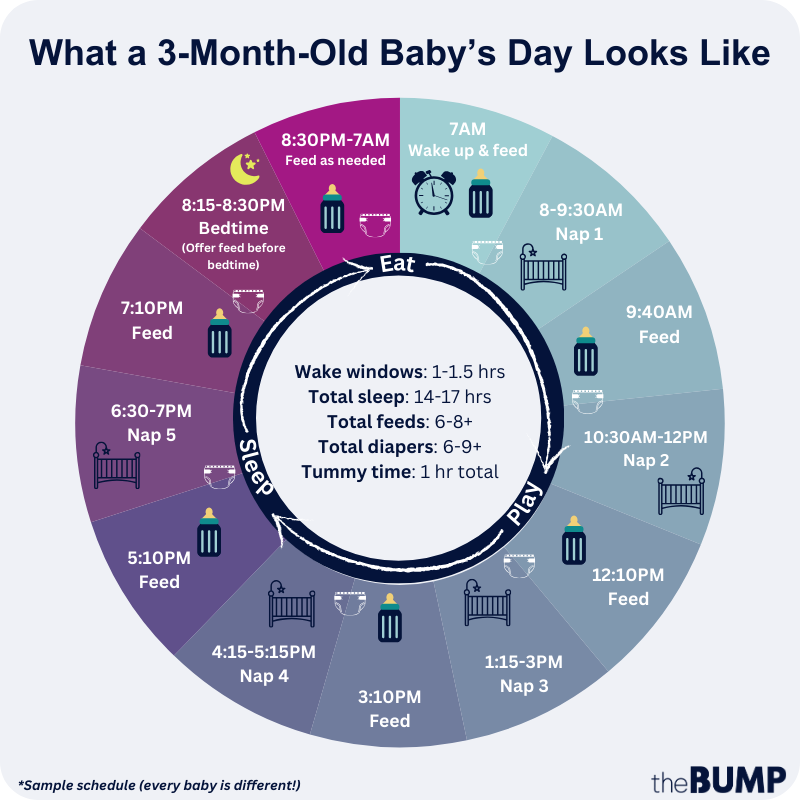 Example 3-month-old daily schedule balancing feeding, awake windows, and rest
Credit: www.thebump.com
Example 3-month-old daily schedule balancing feeding, awake windows, and rest
Credit: www.thebump.com
How Long Should 3-Month-Old Breastfeeding Sessions Last?
Unlike newborns, 3-month-olds are more efficient feeders, but session lengths still vary widely based on your baby’s appetite, distraction level, and milk supply. There is no “perfect” feed length — what matters most is that your baby is getting enough milk, which you can confirm via output rather than a timer.
Typical Session Length Ranges
Most 3-month-old feeding sessions last 15 to 30 minutes per breast, but this can range from 10 minutes for fast, efficient feeders to 40 minutes for babies who are easily distracted or prefer to graze. Distraction is very common at this age, as your baby is becoming more aware of their surroundings: you may find they pull away to look at a noise or movement mid-feed, which is normal. If you’re worried your baby isn’t feeding long enough, offer the breast again after a short break rather than forcing them to stay latched.
Clear Signs Your Baby Is Full
Learning your baby’s fullness cues will help you avoid overfeeding and build a more natural schedule. Look for these signals that they’re satisfied:
- Pulling away from the breast on their own
- Slowing or stopping sucking, even when you try to encourage them to continue
- Falling asleep at the breast
- Turning their head away when you try to re-latch
- Relaxed, open hands (as opposed to clenched fists during hunger)
A better metric for adequate intake than feed length is diaper output: 6 or more wet diapers a day, and 3 to 4 poopy diapers (or fewer, since breast milk is easily digested) are clear signs your baby is getting enough calories, even if feeds feel short.
Navigating 3-Month Growth Spurts (A Normal, Temporary Phase)
The 3-month mark is one of the most common times for growth spurts, which can throw even the most consistent feeding schedule off course. These phases are temporary and a normal part of your baby’s development, not a sign that something is wrong with your milk supply or feeding routine.
When to Expect Growth Spurts at 3 Months
Growth spurts at this age typically last 2 to 3 days, and often coincide with new developmental milestones like rolling, reaching, or increased cooing. Your baby’s body is working hard to build new skills and gain weight, so they need extra calories to support this growth.
How to Adjust Your Schedule Without Stress
During a growth spurt, your baby may want to feed every 1 to 2 hours, even at night — this is called cluster feeding, and it’s your body’s natural signal to produce more milk to meet their growing needs. Don’t assume frequent feeding means your supply is low: feeding on demand during the spurt will naturally boost your supply within 24 to 48 hours. After the spurt ends, your baby will return to their usual feeding schedule, and you’ll likely notice they’ve suddenly fit into 3–6 month clothing or hit a new skill. After a 3-month growth spurt, you may find your baby has outgrown their current wardrobe, so check our guide to seasonal baby layering to ensure they’re dressed comfortably for outdoor outings.
 Visual guide to recognizing and responding to 3-month growth spurts
Credit: cheerschildcare.com
Visual guide to recognizing and responding to 3-month growth spurts
Credit: cheerschildcare.com
Common 3-Month Breastfeeding Hurdles (and Practical Fixes)
Even with a solid routine, you may run into common breastfeeding challenges at this stage. These are almost always temporary, and most have simple, actionable fixes.
Latching Difficulties
At 3 months, babies become more distracted during feeds, which can lead to frequent breaking of the latch and soreness for parents. To improve latch:
- Feed in a quiet, dim space to minimize distractions
- Try a laid-back nursing position, where you recline slightly and let your baby rest on your chest to encourage a deep, natural latch
- Use the football hold if you’re recovering from a C-section, as it keeps pressure off your incision
If you experience persistent pain, or your baby is not gaining weight as expected, consult an IBCLC (International Board Certified Lactation Consultant) for personalized, hands-on support.
Low Milk Supply Concerns
Low milk supply is rare for most parents, and many concerns stem from normal feeding patterns during growth spurts. To support a healthy supply:
- Feed on demand rather than sticking to a rigid schedule, as frequent removal of milk signals your body to produce more
- Avoid supplementing with formula or expressed milk unless explicitly recommended by your pediatrician, as this can reduce your supply over time
- Stay hydrated, eat enough calories, and rest when you can to support milk production
If your pediatrician does recommend temporary formula supplementation to support your baby’s nutritional needs, our breakdown of common formula ingredients can help you select a product that aligns with your family’s preferences.
Persistent Nipple Pain
Mild soreness is common in the first few weeks of breastfeeding, but pain that lasts beyond 3 months is not normal. To address ongoing discomfort:
- Check for tongue tie or lip tie, which can make latching shallow and painful
- Ensure your baby is latching deeply, with more than just the nipple in their mouth
- Apply purified lanolin cream after feeds, and air dry nipples between feeds to prevent cracking
- Use hydrogel pads for temporary relief of soreness
Pro Tips for a Smooth Breastfeeding Routine
Small, intentional adjustments can make feeding sessions more comfortable and efficient for both you and your baby:
- Prioritize your comfort: Use a firm nursing pillow to support your back and arms, keep a water bottle and healthy snacks (like granola or fruit) next to your feeding spot to stay hydrated and fueled, and wear loose, breathable nursing clothes that make latching easy.
- Build a support system early: Connect with other breastfeeding parents via local groups or online communities, ask your partner or family to help with burping, settling, or household tasks after feeds so you can rest, and don’t hesitate to reach out to an IBCLC if you have questions or concerns.
- Plan for stress-free on-the-go feeds: Pack a dedicated breastfeeding bag with a nursing cover, extra burp cloths, a portable breast pump if you need to pump when out, and a change of clothes for you and baby. If you’re planning day trips around your baby’s schedule, our tips for outings with early sleepers will help you avoid missed feeds and overtired meltdowns. Dress your baby in soft, loose layers for feeds to avoid restrictive clothing that interferes with latching, and check our guide to appropriate sock counts for infants to keep their feet warm without overheating during cooler months.
Frequently Asked Questions About 3-Month-Old Breastfeeding Schedules
How many times a day should a 3-month-old breastfeed?
Most 3-month-olds breastfeed 6 to 8 times in 24 hours, with some feeding up to 9 times during growth spurts. Feed on cue rather than sticking to a strict clock, as hunger cues will vary day to day based on activity level and growth needs.
How long can a 3-month-old go between daytime feeds?
Most 3-month-olds can go 3 to 4 hours between daytime feeds, though some may go as long as 5 hours if they had a longer or more calorie-dense feed earlier in the day. If your baby is consistently going longer than 5 hours between feeds and has fewer than 6 wet diapers a day, check in with your pediatrician to rule out any feeding issues.
Do 3-month-olds need nighttime feeds?
Many 3-month-olds can sleep 4 to 6 hour stretches at night without a feed, but 1 to 2 nighttime feeds are completely normal, especially during growth spurts. Night feeds help maintain your milk supply and ensure your baby is getting enough calories for growth, so don’t rush to night wean unless your pediatrician says it’s appropriate.
What is the 6-6-6 rule for breastfeeding?
The 6-6-6 rule is a widely accepted global breastfeeding guideline endorsed by the World Health Organization and American Academy of Pediatrics: exclusive breastfeeding for the first 6 months, continued breastfeeding alongside complementary foods until at least 12 months (or longer if mutually desired by parent and baby), and full weaning by 2 years of age if that works for your family. This approach supports optimal infant nutrition, immune health, and parent-baby bonding.
Final Thoughts
The 3-month mark is a fun, evolving phase of breastfeeding, and there is no “perfect” schedule that works for every family. The best routine is one that prioritizes your baby’s hunger cues, supports your milk supply, and fits your family’s lifestyle. Trust your instincts, don’t compare your journey to others, and reach out for professional support from an IBCLC or pediatrician if you need it. Celebrate the small wins, like a longer sleep stretch or a fuss-free feed, and enjoy the quiet bonding moments that breastfeeding brings.
If you’re navigating other early parenting milestones, from setting up your baby’s nursery to planning first outings, our library of evidence-based guides has practical, parent-tested tips to support you every step of the way. As your baby approaches 6 months, you’ll likely start exploring solid food introductions alongside continued breastfeeding to meet their growing nutritional needs.

Sophia Linda is a freelance writer and Certified Health Coach based in the Newbury Park, CA. Passionate about healthy living, she focuses on helping families stay active and connected to the outdoors. Together with her husband and their three young children, Sophia spends much of her time traveling, hiking, and camping. Her work has been featured on the bestbabycart blog, and she brings a practical, real-world perspective to reviewing baby products for parents.